

Enjoyed this recipe? Add us to your Google Search Preferred Sources:
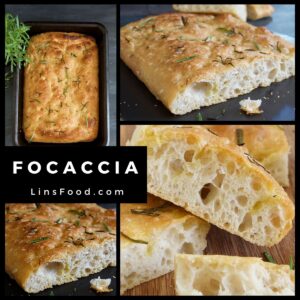
This is the basic focaccia recipe that I use for every kind of focaccia I make! It’s also the one that my students learn in our Italian breads classes. This focaccia is salty and crispy on the outside and light, airy and just very lightly chewy on the inside.
Estimated reading time: 11 minutes
Table of contents

What is Focaccia?
Focaccia is one of many Italian traditions! It’s a flatbread made with a generous amount of olive oil, and has a long history.
From Marcella Hazan’s Essentials of Classic Italian Cooking:
“Before there was an oven, there was bread. It was baked in the hearth, where the dough was flattened over a stone slab and covered with hot ashes. From this hearth bread—panis focacius (focus is Latin for hearth)—comes today’s soft, leavened focaccia.”
Italian Focaccia Recipe
Let me tell you, there isn’t a single, authentic, Italian focaccia recipe! Focaccia is closely associated with Liguria, and specifically, Genoa. But naturally, it is to be found all over Italy. And, it does take on different forms and different names, depending on where you are.
- In some places, it may be less than an inch thick (my favourite kind)
- In others, it is 2 inches thick
- In Puglia, focaccia is made with potatoes and this is also where the stereotype image of focaccia comes from – dotted with cherry tomatoes
- I’ve even had a simple, salt and rosemary focaccia in Rome, that was as thin and crispy as a pizza base
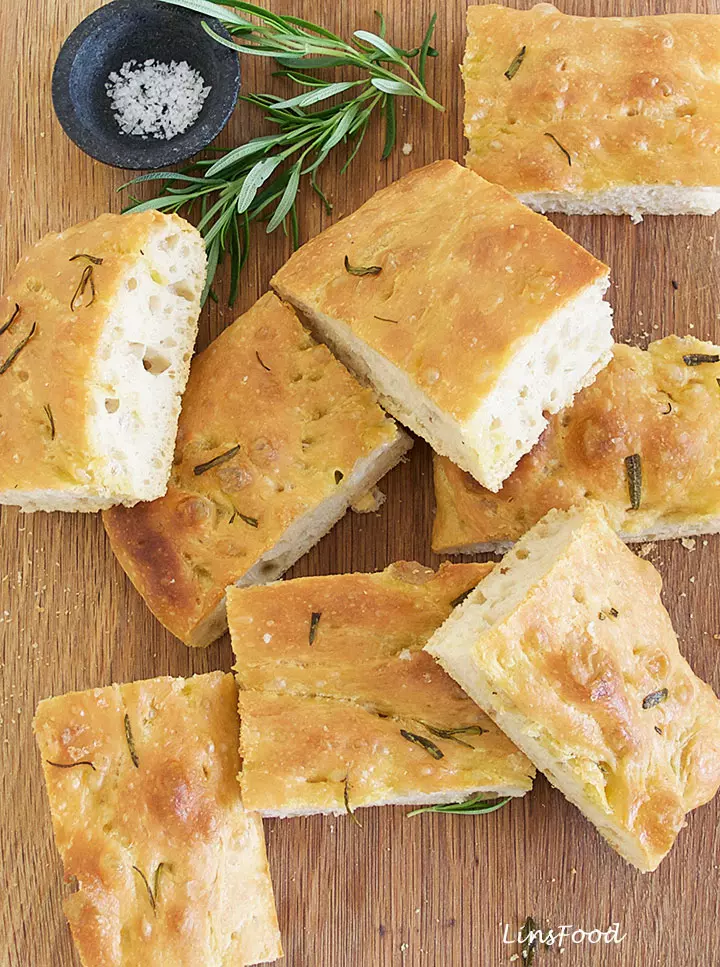
Recently, one of my friends showed me a picture of a long, thin bread sold at her local bakery, called schiacciata. The first thing I said was that it resembled focaccia. And the name certainly rang a bell, but for the life of me, I couldn’t recall why or how.
The mystery was finally solved, when I came across this in Marcella Hazan’s book:
“In many cities of the north, in fact, it is not called focaccia at all, but pizza genovese, Genoese-style pizza. In Bologna, however, if you are looking for focaccia, the appropriate word to use is crescentina; in Florence, Rome, and a few other parts of central Italy, it is schiacciata.”
That’s how I knew of the name – from the book. Or so I thought!
When I mentioned it to my husband later that evening, he was amazed that I couldn’t recall a similar conversation we had in Tuscany some 10 years ago, when we first came across schiacciata. This is the husband who doesn’t remember conversations from the day before.
Apparently, we came across various panetterie (bakeries; singular = paneterria) selling focaccia under different names. He couldn’t remember the others but he does remember schiacciata and focaccia. A quick email to a born and bred Tuscan friend the next day, confirmed that fact, and also provided two more names: ciaccino and ciaccia.
So, focaccia can be called a number of things, and also comes in various guises:
- ciaccia
- ciaccino
- schiacciata – it means “squashed”, by the way
- schiacciata toscana
- focaccia toscana
- pizza bianca (which is also a thing that’s not focaccia!)
- thin and cripy
- thick and soft/chewy
- crispy on the outside, soft and chewy on the inside
Yeah, it’s terribly confusing! Depending on where you are in Italy, and who you are talking to, it can mean the same thing, OR NOT!
Let’s face it, Italian food is a compilation of a wide range of recipes that existed before the formation of what we know now, as Italy. It is a collection of regional recipes: Milanese, Piedmontese, Tuscan, Roman, etc., rather than one single cuisine.
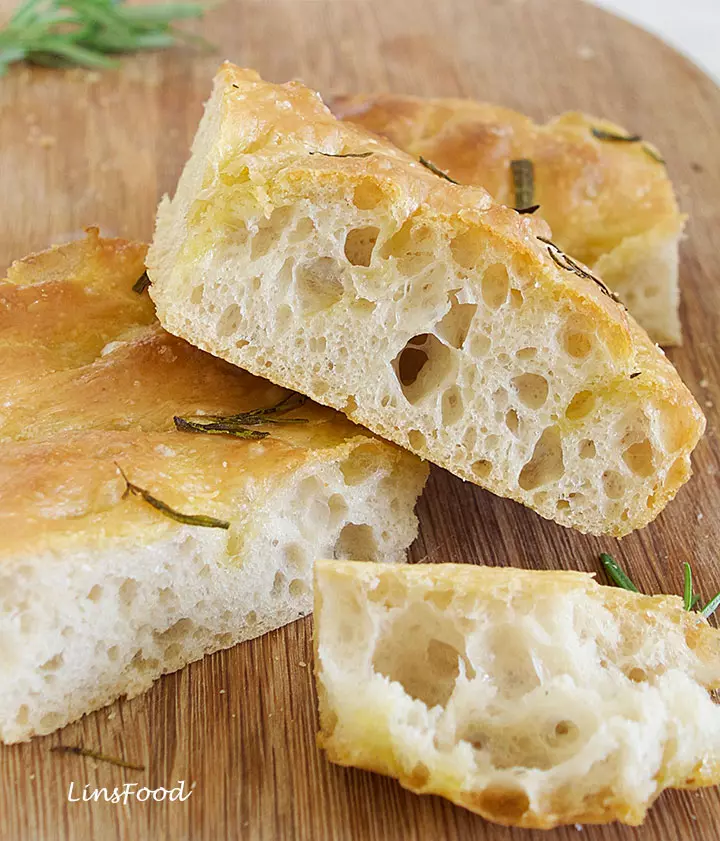
But let’s just talk about the basic focaccia recipe now!
So we’ve ascertained that there is no single, or traditional, or authentic focaccia recipe. Or even perfect. One man’s perfect is another man’s erm, imperfect? Imperfection? Flaw? Nightmare?
It does take a little time, not so much effort, but time. However, in that time, you could go wash your hair, paint your nails, weed the garden, or just put your feet up. With the regulatory glass of wine. Or java.
The final result of the homemade focaccia is, need I say it, so much better than anything from the supermarket!
So our basic focaccia recipe takes 2 days.
What?!
Well, most of that time is hands off. Remember: wash hair, hoover house, watch Netflix?
And this is how we do it:
- Make the poolish the night before (pre ferment, more below) – 5 minutes
- Make the dough in a food processor – 15 minutes
- Tip dough in bowl: first rest – 1 hour
- Tip risen dough in baking tin: second rest – 30 minutes
- Add oil and topping: final rest – 20 minutes
- Bake – 30 minutes
Actual hands on time = no more than 30 minutes!
Focaccia Ingredients
A good focaccia, to me, should have a crisp, salty crust and a light, but slightly chewy texture. The mark of a good focaccia is those air pockets you see in the crumb. Just like our Persian flatbread, Barbari.
All we need to make basic focaccia is:
- Flour
- Water
- Yeast
- Olive oil
- Salt
Everything else is extra. Let’s take a look at the individual ingredients.
Focaccia flour
It is all a matter of taste. Some people use regular plain flour, some use “00”, some use bread flour, and some use a mixture of 2 different flours.
I like to use bread flour. I’ve tried them all over the years, and have found that bread flour gives the best result in terms of texture, crumb and crust.
Having said that, I have been known to change it up and use plain flour. Because change is always good! You never know what you might like a few months or years down the road.
Yeast and Poolish for Focaccia
While many people are happy to make focaccia with just dry active yeast (or even fresh), I much prefer the overall texture and flavour when making it with biga, poolish or sourdough. I am a big fan of pre ferments.

What is Poolish?
Poolish is French. It is a starter, a pre ferment, like the Italian biga. Poolish is pretty wet, compared to the Italian biga, and is made with flour, water and yeast (or sourdough). You mix the 3 things up, leave it aside for anything from 8-16 hours, then make your bread.
Poolish usually has the same amount of flour to water (100% for each), compared to Biga, which has about 60% water to the flour amount. In “bread speak”, that’s 60% hydration. But that’s a whole new post for another day.
Using a starter (poolish, biga or sourdough), instead of just straight up yeast, gives you a better tasting bread with a superior texture.
Why am I using French poolish instead of Italian biga for an Italian bread?
I’ve tried them both, but the poolish consistently gives me a lighter focaccia then when using biga. Really, they are just names for starters.
If I find that I am delayed for more than 2 hours the next day, I just place the poolish in the fridge to stop it from maturing any further.
If it’s winter time, keep your poolish or biga in the warmest part of the house. The airing cupboard will be rather perfect.
Water in Focaccia
There is no getting away from it – focaccia, like ciabatta, is a very wet dough. This, along with the resting times, is what gives you the texture synonymous with a good focaccia.
Given its wet nature, you really, really want a food mixer for it.
Can you make focaccia without a food mixer?
Yes, but it’s a bit of an effort. You will not get as good a crumb and texture if kneading by hand. Why? Because focaccia is a wet dough. A sticky, wet dough. Kneading it by hand will require anti sticking agents like flour or more oil, which will mess with the recipe ratio.
In ancient Rome, and during the Renaissance, it might have been done by hand. Ok, your great grandmother might have kneaded wet dough by hand, but that was before the day of 30 minute dinners, and don’t break a sweat while cooking.
If you’ve got the time, and the inclination, by all means. But investing in a small food processor might be an easier option!
Olive oil in Focaccia
Use a very good quality extra virgin olive oil, as you will be tasting that oil in your focaccia.
Salt
Salt flakes are preferable in making focaccia. And here in the UK, the standard is Maldon.
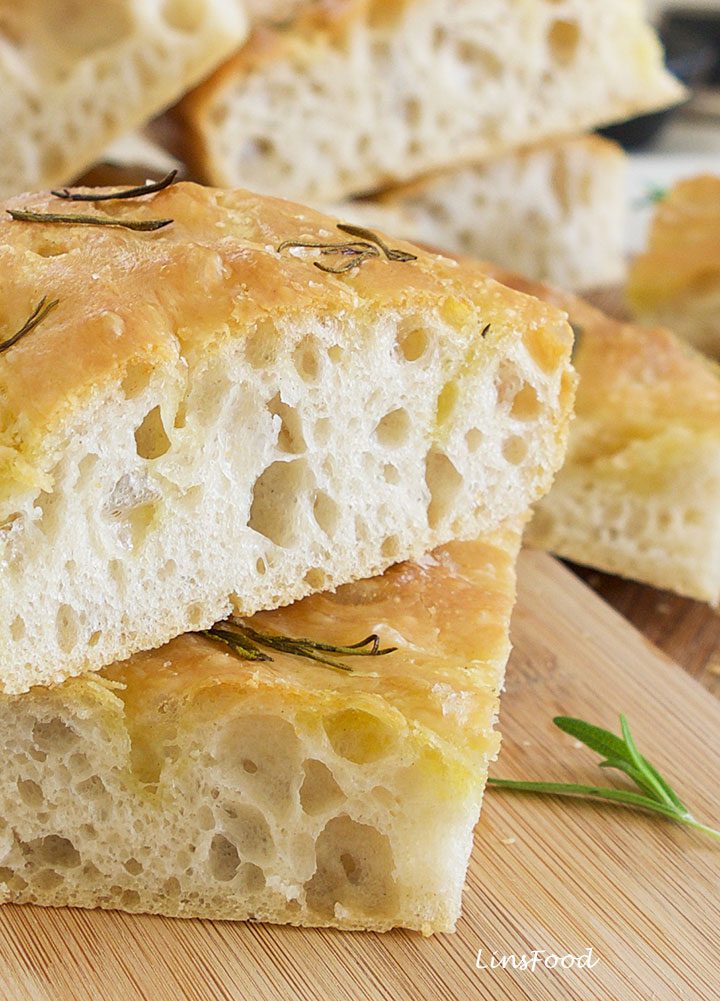
Focaccia Toppings
So the recipe I give you here is my basic focaccia recipe, right? As mentioned above, I use it for all sorts of interpretations, whether adding to the recipe, or just topping. Here are some ideas for topping focaccia:
- herbs like rosemary, basil, thyme, parsley
- spices like fennel, chilli flakes
- vegetables like tomatoes, bell peppers, sundried tomatoes, marinated vegetables
- olives
- onions, garlic, chillies
- fruit like grapes and figs
- anchovies
- balsamic vinegar
- pesto
- cheese
- sausages and other cured meats
Olive Oil Topping for Focaccia
Oil and Water Paste
Some people will make a paste with olive oil, water and salt to rub over the dough before baking. This creates a translucent layer on the focaccia which is not really to my liking. So I just drizzle olive oil and sprinkle some salt all over.
Flavoured Olive Oil
Another popular thing to do is to lightly heat some extra virgin olive oil and flavour it with herbs of your choice: rosemary, oregano, thyme, and also spices.
Leave the oil to completely cool, and use this to brush over the dough before baking.
How to Serve Focaccia
Focaccia is best eaten warm, and straight out of the oven.
Serve focaccia with any meal, instead of your regular bread. It’s great with salads, stews, soups and curries! You can also slice your focaccia in half and fill it like a sandwich.

How long does Focaccia Keep?
Keep it in an airtight container and it will last 2 days. While the flavour of the day old focaccia is perfectly delicious, the texture will be different. The crust won’t be as crispy, and will take on the slightly chewy texture of the crumb.
You can also freeze focaccia.
For both instances, warm it up in a hot oven which will crisp up the crust slightly, or the microwave oven. The latter will not crisp up your focaccia in any shape or form. If you’re planning to dunk your focaccia, that doesn’t really matter, does it?
Shall we take a look at the recipe?
Focaccia Recipe in Pictures


More Italian Recipes on LinsFood


If you like the recipe, don’t forget to leave me a comment and that all important, 5-star rating! Thank you!
And if you make the recipe, share it on any platform and tag me @azlinbloor, and hashtag it #linsfood
Lin xx
Basic Focaccia Recipe (and EVERYTHING you want to know about focaccia!)
Equipment
- A large mixing bowl, preferably with a dough hook
- Bowls for the poolish and the dough
- You will need a baking tin measuring about 13" x 9", at least 2" high
Ingredients
Poolish
- 200 g bread flour
- 250 ml water
- ¼ tsp dry active yeast
Focaccia Dough
- 4 Tbsp water
- 1 tsp dry active yeast
- 130 g bread flour
- ½ Tbsp salt
- 4 Tbsp EV olive oil
Topping
- 5 Tbsp EV olive oil
- 1 tsp salt flakes preferably Maldon
- 1 sprig rosemary leaves picked
Instructions
The night before, make the Poolish (12 hours before you plan to start the next day)
- Mix the flour, water and yeast in a roomy bowl and whisk with a wooden spoon to mix well.
- Cover with clingfilm and leave in the kitchen overnight. If you are not starting about 12 hours after mixing the poolish, place the poolish in the fridge until you need it, but no more than 4 hours.
The Next Day, mixing and kneading the Focaccia dough
- Dissolve the yeast in the water in your mixing bowl, a wooden spoon is best for this, it’ll only take 20 seconds or so.
- Add the poolish, flour, followed by the salt, in that order.
- Using a dough hook, mix the ingredients on low until the flour is no longer "flying". Then increase to high (5 on my Titanium Chef) and mix for 8 minutes, until the dough is beginning to pull away from the sides. That means that it is stretching slightly, all around, while sticking to the sides. Scrape down the sides in the for couple of minutes, if you have to.
- Lower the speed to low and drizzle in the 4 Tbsp of oil, while the dough hook is still moving.
- Increase the speed back up to high and mix for 3-5 minutes. At around the 3 minute mark, you will hear loud slapping sounds coming from your food mixer. Go take a look. If the dough is moving around in practically a ball shape, it is done. You can proceed with the next step.
First Rest
- Tip the dough into a large, lightly greased bowl. Use a spatula to help it away from the mixing bowl, it should just come away easily.
- Cover with a damp tea towel and leave to rest for 1 hour.
- Line your baking tin with baking paper if it’s not non stick. Just in case!
Second Rest
- When the hour is up, tip the wet, risen dough into the middle of the tin. Lightly cover with clingfilm and leave to rise for 30 minutes.
Final Rest
- At the end of 30 minutes, drizzle 1 tablespoon of olive oil all over, and push the focaccia dough, starting from the middle, to fit the tin. It should already be almost covering it anyway. Let the dough rest for another 20 minutes. Don’t be tempted to pop those bubbles, apart from the ones you naturally touch as you are spreading the dough. We want those bubbles in our bread dough.
- Preheat the oven to 240˚C/475˚F.
Topping and Baking the Focaccia Dough
- At the end of those 20 minutes, using the tip of your fingers, poke your dough all over to create dimples. Don’t worry too much if you don’t get pronounced dips.
- Drizzle another 2 tablespoons of olive oil, and scatter the rosemary all over. Finish off with a sprinkle of the salt flakes.
- Bake on the middle shelf for 25-30 minutes, until the top is a beautiful golden brown and crispy.
- Take it out of the oven, leave it to rest for 10 minutes, before cutting into squares. Before cutting, you can drizzle the final 2 tablespoons of oil all over, if you like, which will give a wet feel to some part of the focaccia. I do it, but its a matter of taste.
Notes
Nutrition
Enjoyed this recipe? Add us to your Google Search Preferred Sources:


This is a brilliant focaccia recipe. It turned out light and fluffy on the inside and crispy and flaky on the outside. The size is right too. I used a KitchenAid Artisan stand mixer, setting 6 for the high setting. I used a 9″ diameter 3″ height round glass baking dish lined with parchment and greased with olive oil. I baked it for 45 mins to make sure the centre wasn’t doughy. My toppings got a little bit charred so that’s something to think about. Thank you, I’ll be using this recipe the next time I’m craving focaccia.
My pleasure, Jord. Thank you for sharing that.
I only bake bread recipes that incorporate poolish as the pre~ferment for better texture and taste. I added a couple more tablespoons to the flour mixture during the mix and topped with sun~dried tomatoes and rosemary before going into the oven. In one word, delicious!
That’s wonderful. And I’m with you on poolish!
I just tried to make it and I made the poolish and put all the ingredients in the dough as stated and drizzled the oil in but it didn’t turn into a ball or “slap” around the sides after 5 mins so I chucked it out. What could of gone wrong?
Hi Erin, my focaccia recipe creates a very, very wet dough and you won’t really end up with a ball as such. Perhaps I should not have used the word “ball”, as I’m talking more about smooth surface coming away from the side of the bowl. If your dough isn’t forming at all, you could try sprinkling 1 Tbsp of flour at a time while you keep whisking with the dough hook.
I’ll add your question as as FAQ to the post. And I’ll add this recipe to the list of videos I should make.
Have another attempt, Erin, and see how it goes. Sometimes, you also just need to keep working the dough a little longer.
Can I add 1 tsp of garlic powder to this dough to give it a tad more umph, and if so when should I add it. If doing this should I decrease the flour by 1 tsp . Making it now, so we’ll see what happen s
You certainly can, without the need to change the flour amount as it’s rather negligible. Let me know how it turns out.
found
Good to know.
Oops, fond the converter… Well done!
It would be nice to have volume measurements in brackets for those of us who prefer to scoop over weighing. Yeah, we get it, weighing is more accurate but what a hassle. We can adjust moisture on the fly by eye if necessary.