

Enjoyed this recipe? Add us to your Google Search Preferred Sources:
Halawet el Jibn is an exquisite dessert of semolina and cheese rolls topped with rose or orange scented sugar syrup, and is simply perfect for any occasion.
Estimated reading time: 12 minutes
Table of contents

Halawet el Jibn
Let’s look at the name first, shall we? In Arabic:
- halawet = sweet, sweetness, dessert, along those lines
- el = the (definite article)
- jibn = cheese
So, Halawet el Jibn can be translated as sweetness of the cheese. Or simply, sweet cheese, or even cheese dessert.
Pronunciation
- Halawat = a is pronounced as in “car”
- el – also the same vowel sound, so like the u sound in mull.
- Jibn – just imagine there is an e between the letters b and n, so ji-ben (as in burn, silent r).
Halawet el Jibn comes from the city of Hama in Syria. Like many other Levantine and Middle Eastern desserts, it has long been a favourite all over the region, even finding its way to the Mediterranean.
It is a must have-recipe during Ramadan and for some people, Eid. And because Syria has a sizeable number of Catholics, it is also a recipe for Easter, for many families.
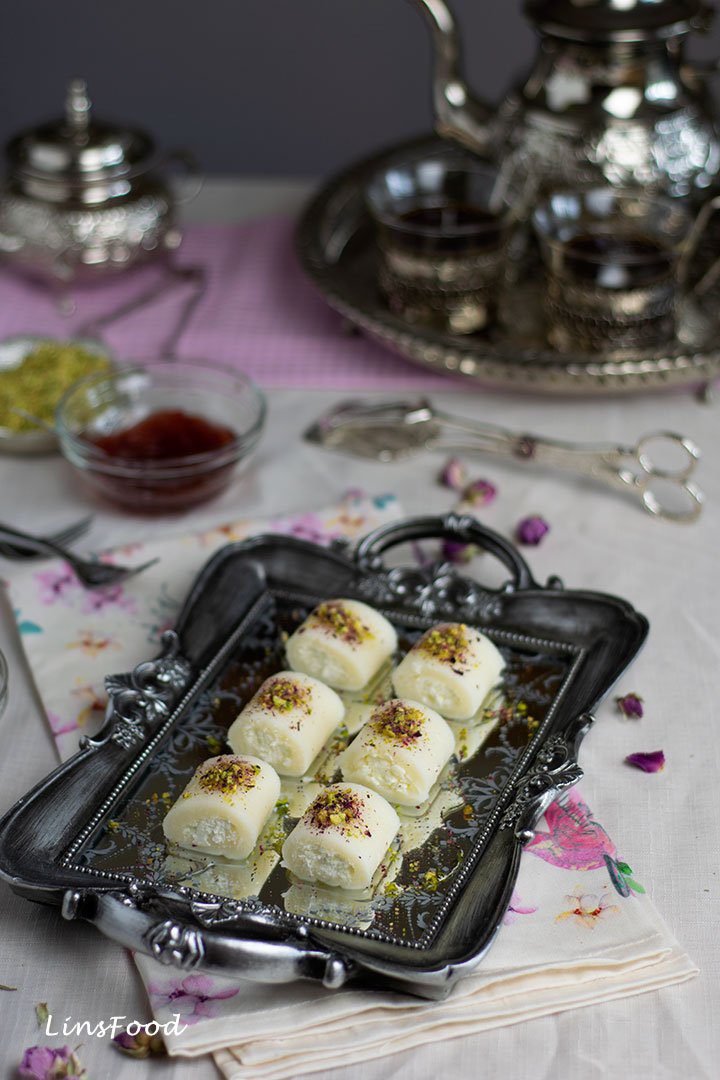
Ingredients at a glance
Halawet el jibn is basically four components:
- Scented sugar syrup (rose water or orange blossom water)
- Sweet semolina cheese dough
- Ashta filling (or a shortcut substitute)
- Toppings: pistachios, optional rose petal jam/dried rose petals
Those are the pillars. Get those right and you get sweet shop results.
The Steps at a Glance
The magic of halawet el jibn lies in texture. Too much heat and the dough tightens. Too little cooking and it tears. The goal is a smooth, pliable dough that rolls thin without cracking.
If you want the whole method in one quick glance:
- Cook the semolina with sugar and water briefly.
- Add cheese and flower water and stir until it becomes one cohesive dough.
- Roll the dough between sheets of clingfilm/baking paper while still warm.
- Pipe a line of ashta (or mascarpone), then roll into logs.
- Chill briefly if you want cleaner cuts.
- Slice, plate, drizzle with syrup (but don’t overdo it), top with pistachios.
That’s it. The “difficult” part is mostly that it’s sticky and you need to be confident, not delicate.
Key takeaway points:
- Use a mild, stretchy cheese. It must melt smoothly without splitting.
- Use fine semolina, not coarse.
- Roll while warm. Once cold, the dough firms up.
- Do not oversoak. This is not baklava; it should be moist, not swimming.
The only part that a first timer may struggle with, is the actual rolling of the dough into logs, as the dough can be a little sticky.
This can be solved with using clingfilm to roll and handle the dough or wet your hands with the sugar syrup you made earlier. You could even use disposable kitchen gloves for this part to stop the dough from sticking to your hands.
Whatever works for you.
Plan B (Emergency “I can’t roll it”)
I was planning to make this Syrian dessert for an event. However, I ran out of time, so you know what I did?
- I got a glass jar, brushed it with the sugar syrup, then placed half the dough and flattened it.
- I then topped this with the ashta filling.
- And finished it with a second layer of dough.
- Then I cut it into squares!
And I can’t believe I forgot to take pictures of the final product!
So in a pinch, if you struggle with rolling, do what I did! Just don’t tell any Syrian auntie!

Troubleshooting
My dough is sticky and mushy. What did I do?
Usually one of two things:
- It wasn’t cooked quite enough. Once it comes away from the pan, keep cooking and stirring for another good 10 seconds.
- It needs a touch more fine semolina. Put it back on low heat and add 1 teaspoon at a time, stirring until workable. You shouldn’t need more than 2–3 teaspoons.
My dough tears when I roll it
Most common causes:
- It cooled too much before rolling. Work while warm.
- You rolled too thin too quickly. Roll gently and evenly between clingfilm/baking paper.
- Too wet cheese (often fresh mozzarella). Drain/pat dry.
My rolls taste bland
That’s normal before syrup and toppings. This dessert is designed to be finished at the end: syrup + pistachios are not optional decoration, they’re the point. Especially the syrup.
My filling leaks out
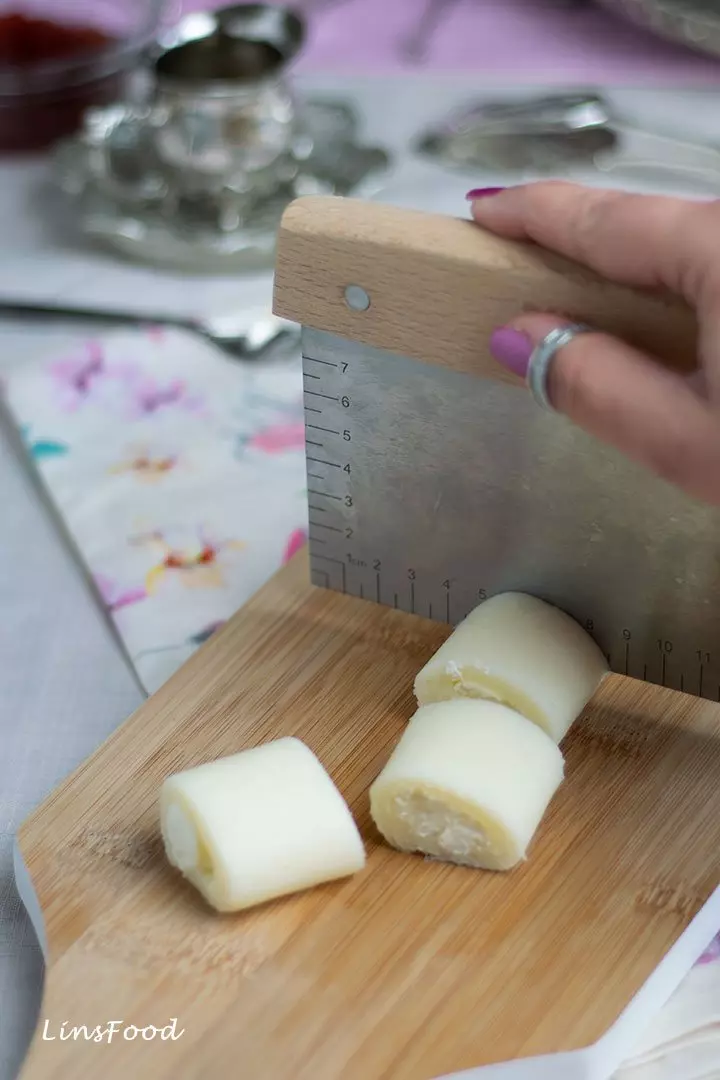
Chill the logs 15 minutes before slicing for cleaner cuts.
Your ashta/mascarpone is too loose (it should pipe and hold shape).
You overfilled. Pipe a neat line, not a duvet.
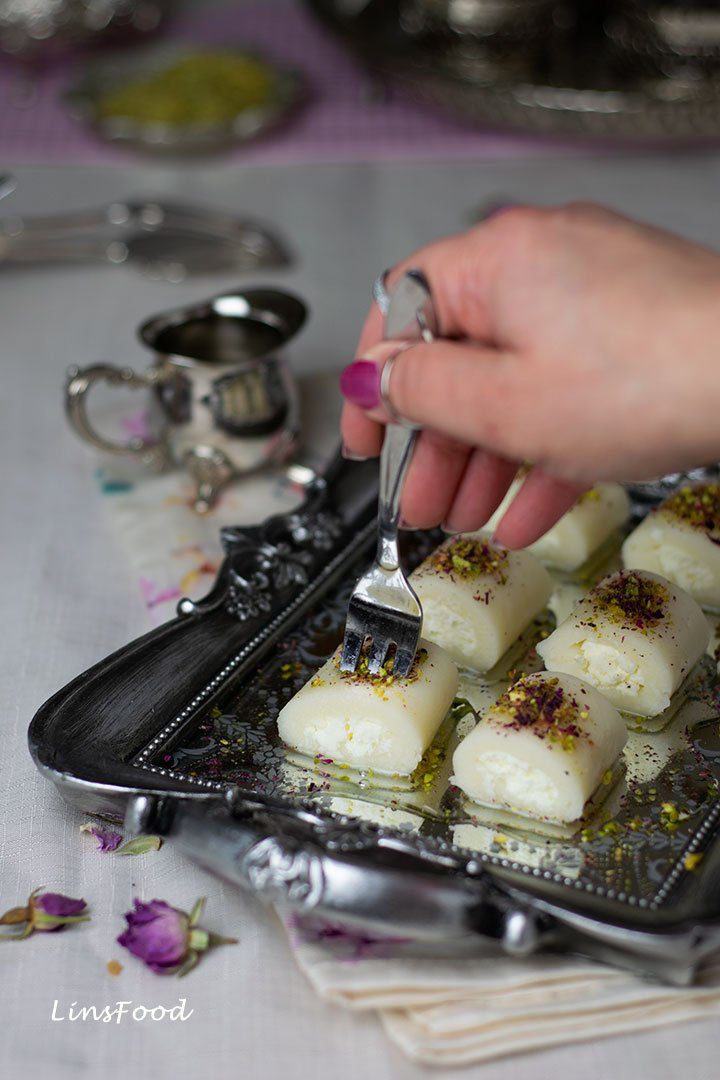
Ingredients
The Cheese for Halawet el Jibn
Traditional halawet el jibn uses Arabic cheeses like akkawi and majdoola, which are stretchy and salty, and usually need soaking/desalting before using in dessert. Mozzarella is the most practical substitute because it’s widely available and melts into a smooth, elastic dough.
It is also a little salty, so you could desalt it before use, if you like. In fact, in the kunafeh recipe here, I suggest doing that. But I’ve long dispensed with the soaking of the mozzarella, just need to update that kunafeh recipe!
A little salt in the cheese is not the enemy. It gives contrast and lifts the flavour of whatever you’re making.
Here’s the quick cheat sheet.
| If you have… | Use it when… | What to do first | Result |
|---|---|---|---|
| Akkawi / Majdoola | You want most traditional flavour/texture | Soak to remove salt, squeeze dry | Classic sweet shop feel |
| Low-moisture mozzarella (block or grated) | You want reliable easy-to-find substitute | Just grate/chop and use | Excellent stretch, easy handling |
| Fresh mozzarella in brine | Only if you must | Drain very well, pat dry hard | Often too wet; dough can go mushy |
| Mixed cheeses | When you want more “cheese” character | Keep salt under control | Can work, but consistency varies |
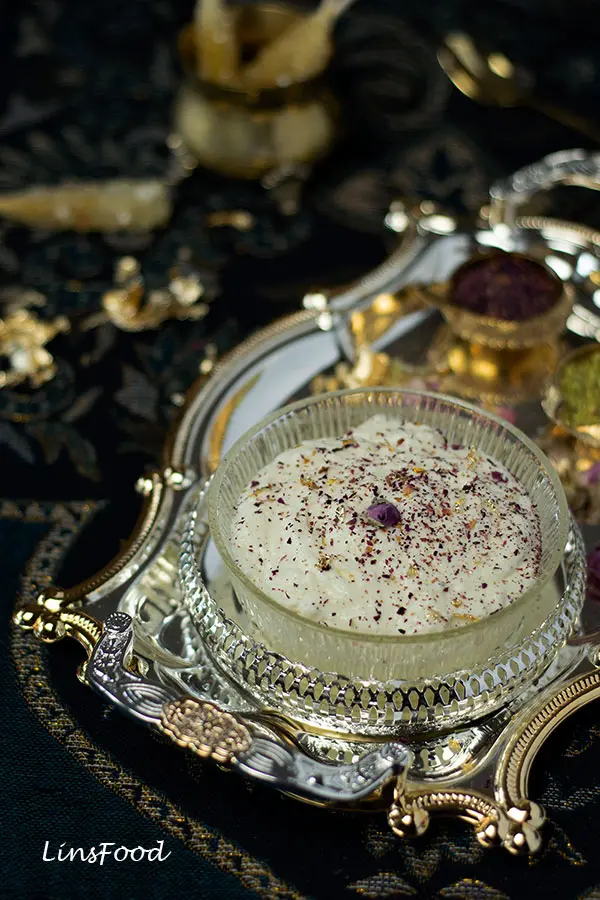
Ashta (the Cream Filling)
So traditionally, the semolina-cheese dough is filled with ashta, the Middle Eastern clotted cream. It started out life as having been made lovingly and patiently by skimming off the skin on boiling milk, again and again until you have enough, and then clotted with vinegar or lemon juice.
These days, there are many ways of making ashta at home, although if you are in the Middle East somewhere, it’s hardly worth the bother, as you can get the real thing easily in your local shops.
Ashta is easily made with boiling some milk, curdling it with vinegar or lemon juice, then thickening it with some cornflour, or even crustless bread. Then you just whip it smooth, if you like, and flavour with rose or orange blossom water.
Click here for our homemade ashta recipe.
However, if you don’t fancy making ashta from scratch, my favourite ashta substitute is mascarpone – one of the best dessert ingredients that ever lived! I’ve given it as a substitute in the recipe card below.
Mascarpone has such a creamy, well rounded flavour that makes it the perfect (better?) substitute for cream in any situation.

Toppings for these Semolina Cheese Rolls
The sweet cheese rolls are fairly bland on their own, with just a hint of sweet and flower power. It is the drizzle of the sugar syrup and the toppings that complete halawet el jibn. This combination of pistachios and flower water is a very, very traditional combination when it comes to desserts throughout the Middle East.
Let’s take a look at how we’ll be topping them.
Ground Pistachios
The ground pistachios add not only a pop of colour but also, a creamy nutty layer of flavour. You don’t need much, just a tablespoon or two.
I prefer to grind the pistachios myself, instead of buying them ground, for a fresher taste.
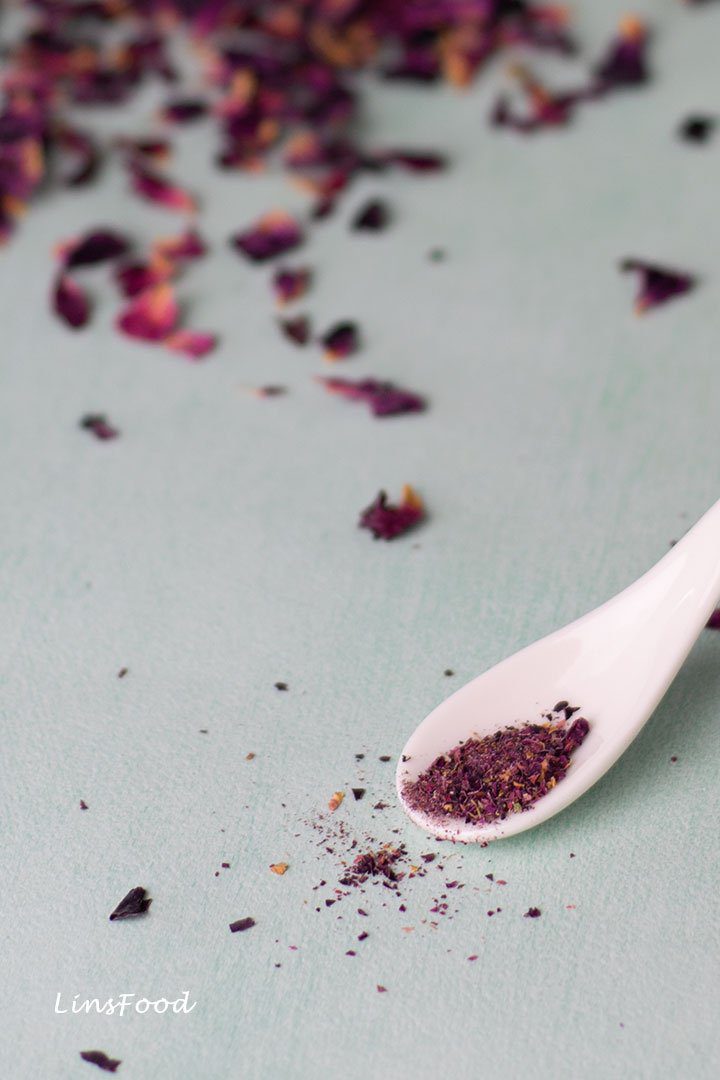
Ground Dried, Edible Rose Petals
Edible rose petals are a favourite ingredient of mine, in both sweet and savoury recipes. These are easily bought online and at specialist shops. If you are in the UK, Waitrose stocks them.
Otherwise, you know Amazon does, click here for the ones I use (affiliate link).
Dried edible rose petals are best used crushed, or ground to a fairly fine state. This way, they become part of the recipe, and you get to enjoy the aroma and flavour without having to bite into a paper-like, damp piece that doesn’t particularly taste great! That’s the only way I can think to describe it!
All I do is place them in my coffee/spice mill and blitz them. They last indefinitely, although after a few months, you’ll probably notice a marked decrease in aroma. Store them like you would any spice, covered, and out of light.

Rose Petal Jam
This adds a lovely, reddish pink look on your halawet el jibn. Rose petal jam is a rather delicious jam that smells and tastes like roses. In the summer, when our organic roses are in full bloom, some of the red ones answer to a higher calling, and get turned into rose water, rose syrup and rose jam.
However, if I need rose petal jam out of season, this is the one I get on Amazon (affiliate link).
And here’s my homemade rose petal jam recipe, if like me, you love flexing those culinary muscles!
I must confess though that I prefer having halawet el jibn without the rose petal jam. Which might explain why I forgot to top them for the photoshoot!
How long will Halawet el Jibn Keep?
Any extra can be kept in the fridge in an airtight container. Halawet el Jibn will keep happily in the fridge for 5 days. In fact, I rather think the flavour improves on the second day. But like cheesecakes, their freshness is at its peak in the first 3 days.
You can serve these sweet cheese rolls straight out of the fridge if you like, something I personally love. Or, you can leave them out for 30 minutes, to come to room temperature, before serving.
Halawet el Jibn FAQs
Alos spelt halawet el jeben, Halawet el jibn is a Levantine dessert made from a sweet semolina-cheese dough rolled around ashta (Middle Eastern clotted cream), sliced into bite-sized pieces, then drizzled with rose water or orange blossom syrup and topped with pistachios.
Halawet el jibn literally translates to “sweetness of the cheese” in Arabic. It’s often described in English as sweet cheese rolls or a sweet cheese dessert.
Halawet el jibn is strongly associated with Hama in Syria and is now enjoyed across the Levant and beyond, especially during Ramadan and Eid.
Traditional recipes use Arabic cheeses like akkawi and majdoola, which are stretchy and salty and usually need soaking to remove excess salt. Low-moisture mozzarella is a reliable substitute because it melts smoothly and is widely available.
Yes. Many home cooks use mozzarella to make these Middle Eastern sweet cheese rolls because it’s accessible and gives a soft, stretchy dough without the soaking step required for saltier Arabic cheeses like akkawi.
Ashta (eshta) is a Middle Eastern clotted cream used in desserts. It’s thick, creamy, lightly scented with rose or orange blossom water, and often used as a filling in sweets like halawet el jibn.
If you can’t find or don’t want to make ashta, mascarpone is a good substitute because it’s thick, mild, and pipes neatly without leaking.
Sticky dough usually means it wasn’t cooked quite enough or it needs a touch more fine semolina. Reheat the dough on low and add fine semolina 1 teaspoon at a time until it becomes workable.
No. Semolina is essential to the texture of halawet el jibn. It’s what gives the cheese dough its structure and signature bite.
Stored in an airtight container in the fridge, halawet el jibn keeps for up to 5 days. For the best texture and freshness, it’s at its peak within the first 3 days
So there you have it, a delicious recipe to try out soon and wow your guests. Shall we get our aprons on?
If you enjoy the recipe, drop me a comment and let me know. And if you are feeling like a star, don’t forget that 5-star rating! Shukran!
And if you make the recipe, share it on any platform and tag me @azlinbloor, and hashtag it #linsfood
Lin xx
More Middle Eastern Desserts



Halawet el Jibn (Levantine Sweet Cheese and Semolina Rolls)
Equipment
- weighing scales
- saucepans (1 small, 1 medium)
- ladles and spoons
- piping bag
- chopping board or tray
- Rolling Pin
- knife or pizza wheel
Ingredients
Halawet el Jibn Syrup
- 250 ml water
- 400 g sugar
- 1 Tbsp orange blossom water OR rose water
Semolina and Cheese Dough
- 200 g fine semolina
- 350 ml water
- 200 g white sugar
- 300 g mozzarella grated or, if using the soft kind, chopped to small pieces, so they melt quicker
- 1 Tbsp rose water OR orange flower water (my advice is to stick to one for the whole recipe)
Halawet el Jibn Filling
- 400 g homemade ashta OR mascarpone
Toppings
- 50 g ground pistachios I always grind them fresh before serving
- 1 Tbsp crushed dried edible rose petals see post for explanation
- rose petal jam as needed (optional, as may not be easy to find)
Instructions
Halawet el Jibn Syrup
- Heat the water and sugar in a small saucepan on medium heat and bring to a simmer. Lower the heat right down and simmer for 5 minutes.

- When done, remove from the heat and leave to cool for 5 minutes before stirring in the orange blossom water. Leave to cool completely before drizzling on the sweet cheese rolls. Can also be refrigerated for a cold syrup, but it will get very thick.Can be made up to a week ahead, and stored in the fridge, covered.


Semolina and Cheese Dough
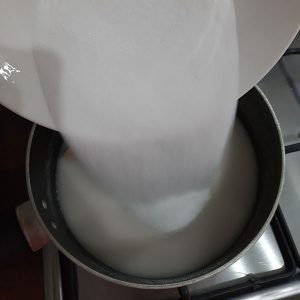
- Place the water, sugar and semolina in a medium saucepan and heat on medium, stirring constantly.
- After about 2 -3 minutes (depends on your heat and how cold your tap water is), you'll see the mixture start to thicken.
- After 20 seconds, tip in the cheese and orange blosson water, and continue stirring. This part does get a little tiring, but it has to be done. Keep stirring until it becomes one big lump of dough, and is coming away from the saucepan, just like choux pastry.It's very important that you give the dough enough time here, to cook. Keep stirring it round and round for 10 more seconds, after it comes away clean from the edges. Otherwise, your dough may be too sticky to work with.
- Take it off the heat and leave to cool for about 20 minutes, until your hands can handle it.


Assembling Halawet el Jibn
- Tip the dough out onto a large chopping board or a clean work surface. Divide it into 3 portions. Cover 2 of them with a damp cloth while you work with one.
- Place a clingfilm on your work surface, then place the semolina-cheese dough on it. Cover with another sheet of clingfilm and roll the dough out with a rolling pin into a rectangle, measuring about 33cm by 25cm (10" x 13").The clingfilm will prevent your dough from sticking, this is something I do with most pastry work, as you'll know from the other recipes on this site.
- Using a knife or pizza wheel, cut off the edges of the rough edges so you get a neat rectangle. Add these cut offs to the two portions of dough.
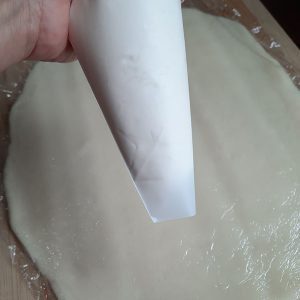
- Fill the piping bag with the mascarpone about halfway up. Snip off about 2.5cm (1") off the end.
- Pipe out the mascarpone along the edge of the semolina dough that's closest to you. Leave about 1cm (½") of space from the edge.
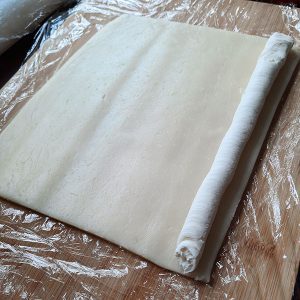
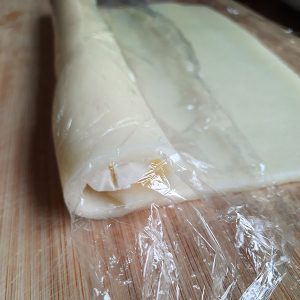
- Now we'll roll the dough up to form a log, like when we make sausage rolls. You can do one of 2 things:1. Roll the dough up with the clingfilm until the mascarpone is completely covered in the dough, with the seam at the bottom. OR2. Wet your hands with the sugar syrup, and roll the dough up without the clingfilm.
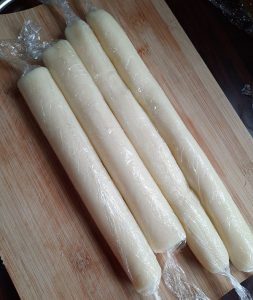
- Then, using a knife or pizza wheel, cut along the edge of the log to "release" it from the rest of the dough. Carefully lift the log up and set it aside on a baking sheet. Be careful, it is fairly soft and may stretch.You could also cut a length of clingfilm and wrap it along the log and twist the ends, then lift the log up to set it aside.
- You should be left with half the rolled out dough to form another log.Get the piping bag of mascarpone and pipe out another length along the edge of the second half of your rolled out dough. Repeat the above step. So roll your dough up to form a log, with the mascarpone fully sandwiched in the dough. Set aside.
- Repeat with the other 2 portions. You will end up with 6-7 logs, depending on the lengths.



Serving Halawet el Jibn
- Cut up the logs into little pieces, about 5cm (2") long, and arrange them on a serving plate. Be sure to wipe your knife between each cut so as not to leave bits of cheese on the next cut. Just like when slicing cheesecakes.
- Drizzle the sugar syrup all over the cut pieces. Then, top with pistachios and rose petals or jam. Leave the syrup on the table for anyone who wants more.Any extra will keep, covered, in the fridge for up to 5 days. If you don't finish them up, that is! You can serve them straight out of the fridge, or leave to come to room temperature for about 30 minutes, if you like. I love them cold.

Nutrition
Enjoyed this recipe? Add us to your Google Search Preferred Sources:


I was a bit surprised they were not baked after rolling
I will DEFINETLY be trying these soon
Thank you for sharing your knowledge with us! I love the way you give so much information, not simply a recipe & how to
My pleasure, Gee. I’m pleased to hear that you enjoy the additional information I love to provide. I think it makes us appreciate the recipe so much more.
Hello! I made this today and although I have made halewet el jeben before I did struggle with the dough. I can’t seem to get it to a “dough” consistency, even after having measured the ingredients exactly and following the steps religiously. It just stays as a sort of mush! Any idea how I can fix this? Thanks!
Hi Taline, that must be so frustrating. 2 solutions:
1. Place the dough in the fridge for 45 minutes to harden, so you can work with it. But I’m thinking that if it’s very mushy, it still won’t keep its shape too well after assembling.
2. Best option – place it back in the saucepan and heat it gently on low heat. Then add 1 tsp of semolina at a time, stirring the semolina in to mix. The semolina will absorb the excess moisture as it mixes and cooks, so this should solve your problem.
Let me know how it goes.
Edit: like choux pastry, this wants to be cooked well on the stove, until it comes away clean from the edges. It may be that you stopped cooking a little too soon.
I’ll add this to the recipe.