
Madeira Cake is easy, basic, buttery-ish, and great for cake decorating with fondant or sugarpaste because of its sturdy nature. But it’s perfect for dunking too!
Estimated reading time: 5 minutes
Table of contents
It’s one of my favourite plain cakes. I love using Madeira Cakes for celebration cakes because its dense texture makes it easier to handle and it lasts for up to 2 weeks. Not only does it last a long time, its dense texture makes it the perfect cake for decorating with buttercream and fondant (sugar paste).
You’ll find handy hints on baking and cake pan sizes below.
Madeira Cake Tips
As Madeira cakes have a dome shape when baked, you could try scooping out the middle of the batter and leaving a little hole in the middle before placing in the oven. This does help produce a flatter top but I don’t bother.
However, you could try placing a flower nail in the middle of your cake pan. I find that this does reduce the dome dramatically.
To level the cake, once you’ve released it from the cake tin, put a saucer in the cake tin and place the cake on top of it. You could then just slice off the dome using the top of the cake tin as a marker.
How long does Madeira Cake Last?
The cake will easily last a week (even 2) if kept in an airtight container, to stop it drying out. This means that if you are decorating it, you can take a couple of days for complicated ideas! Just remember to use a milk free buttercream icing!
Rainbow Madeira Cake
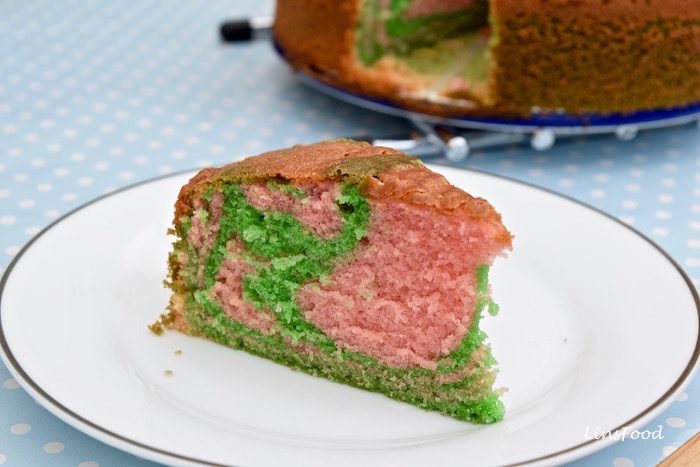
For a rainbow look when you slice the cake, just divide the batter up into 2 or 3 portions and colour with food colouring of your choice.
My granny used to do this with her butter cakes and we grew up calling them rainbow cakes. I like to do this for girls’ birthday cakes and always get a reaction.
Greasing and Lining Cake Pans
In reply to a question posed by a reader, how to know whether to line or not, as written in my recipe card:
Many cake tins used to need lining. These days though, you have the silicone sort and also non lining types. So if yours is an older style tin, grease, line, grease. The first greasing of the pan is to ensure that the baking paper sticks to the pan. Makes filling the tin with the batter so much easier, as the baking paper won’t be moving around in your tin.
Cake pans that don’t need lining will just require some light greasing. If you have just bought your cake pan, it should have instructions. If in doubt, just grease, line and grease.
Cake Pan Conversions (Scaling Up Cake Recipes)
My cake pans all have a depth of between 3 – 4 inches (about 7.5 – 10 cm). You definitely want to use a cake pan that has a minimum depth of 3″ (7.5 cm), to allow for the rise.
Starting with the recipe below for an 8″ cake, multiply by the corresponding quantity for each size.
4″/10cm – divide by 2.5 bake for about 40 minutes
6″/15cm – divide by 1.5 bake for about 45 – 50 minutes
7″/17cm – divide by 1.25 and bake for about 50 minutes
9″/23cm – x 1 and a quarter (1.25) bake for about 1 hour 10 minutes
10″/25cm – x 1.5 bake for about 1 hour 15 minutes
11″/28cm – x 2 bake for about 1 hour 20 minutes
12″/30cm – x 2.5 bake for about 1 hour 30 minutes
How to use Flower Nails for baking cakes?
For larger cakes, above 10″, I would suggest that you use flower nails when baking your cake. This is a flower nail. The reason for this is so the middle of your madeira cake will bake more evenly. As the metal flower nail heats up, it will conduct heat to the batter in the middle, so the sides don’t bake and brown way before the middle.
I much prefer using flower nails to a heating core.
Flower nails can also help to reduce the dome shape of a cake. Madeira cakes do tend to have dome shapes because of their higher moisture content.
How many you use will depend on the size of the cake. You can use more than one, placed at intervals, if necessary, especially if you are baking a long cake. This is how you do it:
- Grease your flower nails. I hate all specially formulated cake release, and only ever use butter for greasing.
- Place your nails upside down in the cake tin.
- Pour the batter over and bake. Remove the cake nails before slicing/decorating.
- Reduce the baking time by at least 10 – 20 minutes. This will depend on the size of your cake.

What are Cake Baking Strips?
Cake baking strips are insulating strips that are place around a cake pan to stop the edges of the cake from baking too quickly, and therefore browning too much. Cakes with a high liquid content, tend to brown quicker, especially eggless cakes.
So baking strips are perfect for eggless cakes.
If you are baking large cakes, whether madeira cake or not, these baking strips also come in handy, you can use them on their own, or in conjunction with flower nails.
Converting round to square cake pans
Move down in number by 1 inch. For e.g.:
8″ round cake pan = 7″ square cake pan
9″ round cake pan = 8″ square cake pan
Other Cake Pan Shapes
Round cake tins = Petal tins (i.e., same measurements)
8″ round tin = 8″ petal tin
Square cake tins = Hexagonal tins
8″ square cake tin = 8″ hexagonal cake tin
For more design ideas, check out the Cake Decorating Page.
You’ll also find lots of helpful tutorials like how to ice and fill a cake and how to cover a cake with fondant or sugarpaste icing.

Madeira Cake Recipe
Ingredients
- 220 g regular salted butter
- 220 g caster sugar superfine sugar (not powdered/icing)
- 250 g AP flour
- 2 Tbsp evaporated milk
- 4 large eggs
- 1 tsp baking powder
- 1 tsp vanilla paste or extract
Instructions
- Preheat oven to 160˚C (fan 140˚C)/320˚F.
- Line and grease your cake tin as required.
- Sift the flour and baking powder.
- Place the butter and sugar into a deep mixing bowl (tabletop mixer is great) and beat until light and fluffy, about 2-3 minutes.
- Add the milk and vanilla and beat to mix thoroughly.
- Add the eggs, one at a time, adding a tbsp of flour with each one and beat for a minute, until well incorporated, before adding the next one. The flour will stop your batter from curdling.
- Add the flour and mix on the lowest speed until just combined. Don’t over mix.
- Pour the cake batter into the prepared tin. I like to lift the tin and firmly tap the base on a firm surface, to level and pop a few bubbles.
- Bake for 1 hour. Insert a skewer in the middle of the cake, if it comes out clean, it’s done.
- Let cool before taking out.
The recipe look great and the handy pan conversion guide is so helpful!
Thank you!
I’m a big fan of cakes, and this cake just went to the top of my to do cakes because its definitely different that what I’m used to. That’s what I love about food blogging.
I totally agree!
this looks so pretty, and I bet it taste amazing, the colors are awesome and it would be so fun for a party. I wonder if I could sub gluten free flour.
You sure can, Andrea. I use this same recipe but with a gluten free mix for clients, when asked.
First of all, it’s great that you take the time to give us all the times and sizes. I personally often get lost while baking because I use different formats. Second, this cake sounds lovely, moist and fun! I’ll definitely give it a try soon!
Thank you Marie-Pierre!
I was expecting Madeira wine in this cake. The recipe looks similar to a basic pound cake. A standard cake recipe is something everyone needs at their finger tips.
Rather deceptive, I can imagine. Yes, it’s a derivation of the pound cake going back to the 17th century.
Hi, I have a 14×9 inch numerical and alphabetical cake tin and would like to know the cake conversion to make the Madeira Cake mixture please.
Hi Jackie, you’ll need the recipe for a 7″ cake.
176g (6 1/3 oz) salted butter
176g (6 1/3 oz) sugar
200g (7 oz) plain flour
1.5 Tbsp evaporated milk
3 large eggs
1 tsp baking powder
1 tsp vanilla paste
Bake for about 50 minutes.
Can you give me quantities for each size for a chocolate Madeira cake Marjorie
Hi Marjorie, I’m working on posting a chocolate madeira cake recipe for you. In the meantime, you might be interested in this Chocolate Cake recipe: https://linsfood.com/chocolate-birthday-cake/
I’ve just followed your recipe for an 11″ round cake and the middle has risen to about 3.8″ but the edges are only 2″. It’s for birthday cake that I plan to cover in fondant icing so once I cut it flat it will only be 2″ high! What could I have done wrong when making it?
Gosh, that’s a huge rise in the middle, isn’t it?
Are you planning to also fill it with jam and icing? As that would give it at least an additional half and inch. Then the fondant on top of that too. I know that still means there isn’t much cake itself.
The rise isn’t because of something you did or didn’t do.
One of the risks of baking a large cake is that you end up with a higher dome than usual. As the edges of the cake get heated up quickly, the batter on the edges set quicker and stop rising, while the middle continues to do so.
To offset this, any of the following:
1. Reduce the oven temperature by 10˚C, as a start, if your oven tends to run hot, by 20˚C.
2. Reduce the leavening agent, in this instance, the baking powder. I would suggest using 1 tsp instead of 2, so half the amount for the 11″.
Unfortunately, there is no way of knowing sometimes, until you’ve baked it once.
I use the exact same recipe above for 12″ cakes for clients, and have yet to encounter what happened to you.
I hope that helps and the cake is still a success.
Thank you! I’m a novice an idiot! I’ve realised exactly what the problem is! I had the oven too high. I had it at 160 and my oven is a fan oven so it should have been 140 degrees! 2nd attempt is now in the oven! I have also made a well in the middle this time. Fingers crossed! If this one is as flat as the other at least I will potentially have 4 sections of cake to pile on top of each other!
Lol, you can never have too much cake! I’m so glad you realised that, because I felt so guilty! Good luck and have fun! x
2nd attempt a huge success! Perfectly flat and a good height. Thanks again for all your advice.
Yay! A glass of wine is called for!
Hello, I need to make 2 x 20cm ball (sphere) cakes and 2 x 16cm ball (sphere) cakes.Can you advise what conversions I would use.
Any advice would be greatly appreciated
Kind regards
Vicky
Hi Vicky, sphere cakes are always a little tricky as they are so much thicker in the middle. Bake them in hemispheres, ie half tins.
If you want to use my recipe above, for the 16cm sphere cake, we’ll use the conversions for a 9″/23cm cake pan:
275g regular salted butter
275g sugar
310g plain flour
2.5 Tbsp evaporated milk
5 eggs
1.25 (quarter) tsp baking powder
1.25 tsp vanilla paste
Bake for about 1 hour 30 minutes at 150˚C, but at the halfway mark, cover the cake tops with baking paper, inserting two cocktail sticks/skewers in to hold the paper down, and bake for another 30 – 45 minutes until the middle is done or the sides are coming away from the pan.
For the 20cm pan, you’ll need to double up on the quantities. We convert cake pans by the volume:
a cake pan with a 16cm diameter will have a volume of 2144 cubic cm
a cake pan with a 20cm diameter will have a volume of 4188 cubic cm
The volume of the 20 is practically double that of the 16.
Any extra batter? Just make cupcakes.
I hope that helps.
PS: Don’t forget to leave a good 2.5cm/inch space for the rise.
Help I am making a 12in 3in deep madeira cake I don’t know how much ingredients I’ve got to use need it to be very moist
Hi Jenni, if you take a look at the conversions above, to bake a 12″ cake, multiply all the ingredients by 2.5 (2 and a half) and bake for about 1 and a half hours.
My recipe above will give you a moist and dense cake, perfect for decorating. I assume that you will be icing and filling. That will also help towards getting a moist cake.
For a 12″ moist cake:
550g (1 lb 4 oz) regular salted butter (i.e. not unsalted or slightly salted, just butter!)
550g (1 lb 4 oz) sugar
625g (5 cups) plain flour
5 Tbsp evaporated milk
10 eggs
2.5 tsp baking powder
2.5 tsp vanilla paste