

Enjoyed this recipe? Add us to your Google Search Preferred Sources:
A showstopping one-pot Palestinian rice dish you cook in layers, then flip out onto a platter like a savoury cake. Maqluba (also maqlooba, maqloubeh, makloubeh) literally means “upside down” – and yes, it’s dinner and theatre in one.
Estimated reading time: 13 minutes
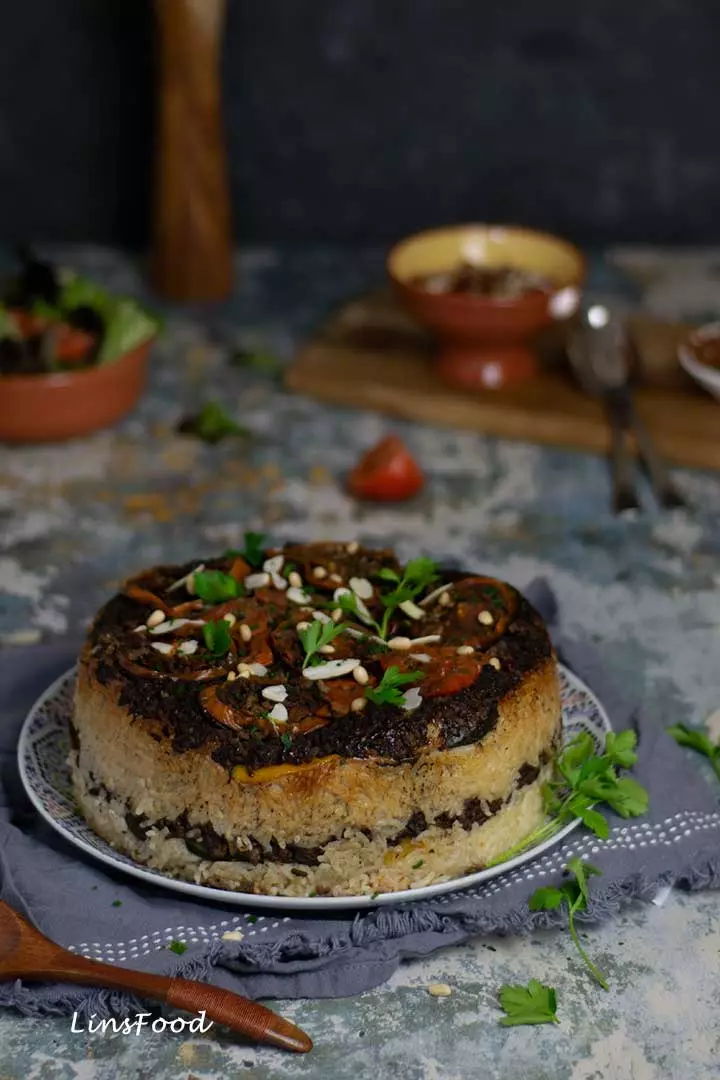
What is Maqluba (Makloubeh)?
Maqluba is a layered rice dish made in one pot: vegetables and meat (or just vegetables) are stacked, topped with rice, cooked in hot stock, then turned upside down onto a serving platter.
It’s comforting, deeply savoury, and one of those dishes that screams nostalgia. The flavours mingle as it cooks, the rice drinks up the spiced stock, and the vegetables caramelise (especially if you roast or fry them first).
You’ll see the name spelled a dozen ways in English – maqluba, maqlooba, maqloubeh, makloubeh – but it’s all pointing to the same glorious moment: the flip.
History of Maqluba (makloubeh)
The name maqluba comes from Arabic and means “upside down”, which is exactly how it’s served.
It’s widely cooked across the Levant (Palestine, Jordan, Syria, Lebanon), with the sort of variation you only get when a dish is truly at home in people’s kitchens: different vegetables depending on season, chicken or lamb depending on budget, and spice blends that lean warmer or brighter depending on the cook.
You’ll often see references to medieval Arabic cookery texts as early written mentions of dishes like maqluba. What matters more (to me, anyway) is that this is living food – the kind that shows up for family gatherings, Friday lunches, Ramadan tables, and “we’ve got people coming” hospitality.
Also, it’s one of those dishes where the name matters. It carries culture, memory, and place – and if you’ve ever eaten maqluba in a Palestinian home (or been fed it by someone who learned it from theirs), you’ll know it isn’t just rice in a pot. It’s a statement of care.

How to make Perfect Maqluba
This is the part where everyone thinks: “Looks complicated.” It isn’t. It’s just a sequence.
Here’s how your maqluba comes together (like a pro):
- Prep the vegetables and rinse the rice.
- Roast the cauliflower (or fry/roast whichever vegetables you prefer for better flavour).
- Cook the minced lamb (or beef) with onions and spices until browned and fairly dry.
- Layer everything tightly in a 20 – 22cm pot: tomatoes at the bottom, then vegetables/meat, then rice.
- Pour over hot stock carefully (the saucer/spoon trick prevents craters in your rice).
- Cook low and steady, then REST before flipping.
- Flip onto a platter, top with pine nuts and parsley, and accept your applause.
A couple of things make the difference between “a neat tower” and “a tasty collapse”:
- Rest 10 minutes. That’s the setting time that makes the flip clean.
- Pack the pot. A tightly packed pot gives you a tightly packed result.
- Use hot stock. It keeps the cooking even and the rice behaves itself.
Ingredients for Makloubeh
Rice
Basmati is ideal here because it cooks fluffy and separate. Rinse it well (and soak briefly if you like, see below) so it doesn’t turn gluey in the pot.
Meat
Minced lamb (or beef), which makes a beautifully even layer and slices neatly when served. Chicken pieces and lamb chunks are also common in other versions, but mince gives you that tidy “cut-and-serve” finish.
Vegetables
I tend to use aubergine (eggplant), courgette (zucchini), peppers, tomatoes, cauliflower and onion. The key is having a combination of:
- something soft and rich (aubergine)
- something with bite (cauliflower)
- something juicy (tomatoes)
- something aromatic (onion)
Spices
Allspice gives that classic Levantine warmth. Turmeric adds colour and a gentle earthy note.
Stock
Hot stock (or water) is non-negotiable if you want the rice to cook evenly. Chicken stock is classic; veg stock works fine for meatless versions. If using water, you will have to increase the salt content.
Garnish
Pine nuts + parsley is the finish that makes it feel festive, even on a random old weekday.
How to Serve
Maqluba is rich and cosy, so you want bright, cool, sharp things alongside it.
Serve it with:
- plain yoghurt, or a quick yoghurt sauce (mint is especially good)
- a chopped salad (tomato, cucumber, parsley, lemon, olive oil)
- pickles (turnip, cucumber, chillies – whatever you love)
If you’re feeding a crowd, maqluba plus yoghurt plus salad is already a complete table. Anything else is just you showing off (and I’m here for it).
Does the Rice want Soaking?
To Soak or not to soak? This depends completely on the quality and type of rice. I went years with not soaking my rice once I came to the UK. And that’s what I’ve been advocating here and in my classes, but ultimately leaving the decision to you guys.
This is because my rice would just fall apart upon cooking. And I’ve never bought “cheap” basmati rice or own brands by supermarkets. I have always gone for brands like Tilda and whatever else that’s in the higher price range.
But not too long ago, I decided to start trying out all the different South Asian rice that a new local “ethnic” shop stocks.
The very first one I tried came with an almost unpleasant smell upon cooking. Flavour was fine though. So I soaked the rice, hoping that this will reduce the smell.
Imagine my surprise when I ended up with aromatic, fluffy, super long grain rice, totally intact!
Moral of the story: properly aged basmati rice wants to be soaked before cooking to produce the best flavour and bite.

The Vegetables in Maqluba
Traditionally, cauliflower, eggplants and capsicums (bell pepper) are the vegetables of choice. I like to add courgettes (zucchini) to the mix for even more variety. I find this limiting and prefer to use both as well as capsicum (bell peppers) and courgettes (zucchinis), the last 3 having a natural affinity with each other.
The vegetables for maqluba are also traditionally fried, before being layered. I prefer to roast them in the oven with a little oil, salt and pepper, not being a massive fan of fried food. Frying or roasting the vegetables give them flavour which transfers onto the final dish.
Feel free to cheat here and get ready roasted vegetables from your supermarket, if you fancy. You’ll find them in the freezer section or in jars sold as antipasti.
The Stock for Maqluba
Many people are happy to add water to the cooking meat, remove the meat, then use the liquid as stock. But I prefer to use additional stock. Also, I find lamb stock overpowering and seldom make it or use it, preferring to use chicken stock across the board.
If you make your own stock, great, if not, use a good shop bought stockpot or cube, no artificial anything. We tend to have frozen homemade stock at home, but there are always some stockpots handy for when we run out, and because they are also very convenient. These are the stockpots that I use. I have them in the whole range.
One stockpot or stock cube is usually for 500 ml (2 cups) of water. So for the amount of liquid in today’s maqluba recipe, 2 stock cubes or pots are perfect, as we have the meat and vegetables to flavour too.
The Saucepan
The saucepan/casserole dish. I believe a tightly packed pan will produce a tightly packed result, giving you a neat maqlooba “tower” that won’t fall apart. For the amount of ingredients here, you’ll need a dish that measures 20cm-22 cm (8″-9″) across ideally.
This is a question I get a lot. The saucepan I’m using in these latest pictures is a stone pot. And here is the link for the whole set.
How to Store Leftovers
Fridge
Keep leftovers tightly covered and refrigerate for 3-4 days.
Reheating (without dry rice)
- Microwave: sprinkle a tablespoon or two of water or stock over the rice, cover, and reheat until hot.
- Stovetop: add a small splash of water/stock to a pan, cover with a lid, and warm gently on low.
Freezing
You can freeze it, but the vegetables will soften more on thawing. If you’re freezing on purpose, cauliflower and potatoes tend to hold up better than aubergine and courgette.
Variations
Chicken maqluba
Use chicken thighs/legs for the best texture. Many versions layer chicken with aubergine and cauliflower. Recipe coming soon – 2026 Feb.
Lamb chunk maqluba
Deeper flavour, great with aubergine and potatoes. This is for all you who want pieces of meat with your rice (me!).
Vegetarian/Vegan maqluba
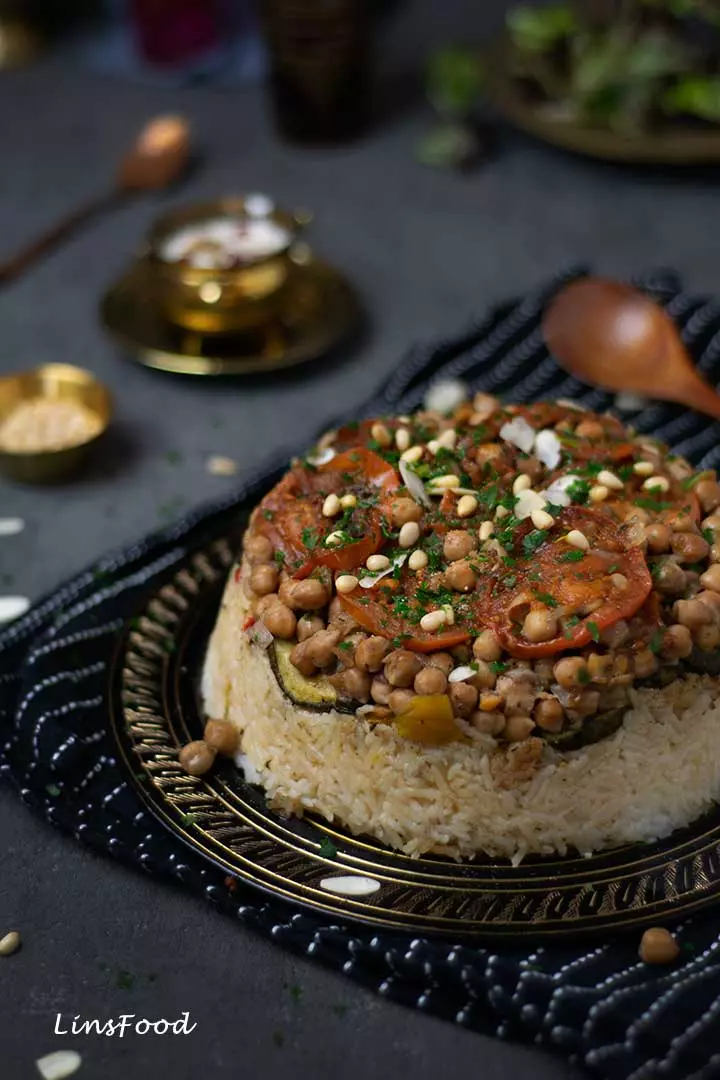
This is so easy to make, just lose the meat. I have a Vegan Maqluba that’s very popular with family and friends. Click here for the recipe.
Serve with salad and a tahini-lemon sauce if you’re skipping yoghurt.
Roasted vs fried veg
Roasting is easier (and less messy), frying is more traditional in many homes. Both are valid. Roasting still gives you colour and flavour, which is what matters.
Maqluba FAQs
Maqluba means “upside down” in Arabic. The dish is cooked in layers in a pot, then flipped onto a platter so the vegetables and meat sit on top and the rice forms the base.
Maqluba is typically made with rice, spiced stock, vegetables (often aubergine, cauliflower, tomatoes and potatoes), and meat such as chicken or lamb. Everything is layered, cooked in one pot, then turned upside down to serve.
Basmati is the best choice because it cooks into fluffy, separate grains and helps the maqluba hold its shape when flipped. Rinse it well to remove surface starch.
The most common reasons are too much liquid, not packing the layers firmly, or skipping the resting time. Cook on low, then rest the pot for 10 minutes off the heat so the rice can set before flipping.
No, but browning the vegetables (fried or roasted) improves flavour and helps some vegetables hold their shape. If you skip browning, the dish will still taste good but may be softer and less defined.
You need enough hot stock to fully cook the rice without flooding it. The exact amount depends on your rice and pot size, but the goal is fully cooked rice that isn’t wet or soupy at the bottom.
A heavy pot with a snug lid helps the rice cook evenly and holds heat well. A 20–22cm pot (about 8-9 inches) is a great size for a tall, tidy maqluba that flips neatly.
Yes. Maqluba keeps well for 3-4 days in the fridge. Reheat gently with a splash of water or stock to stop the rice drying out, and add fresh garnish (nuts, herbs) at serving time.
Yoghurt (plain or minty), a chopped tomato-and-cucumber salad, and pickles are the classic sides. They balance the richness of the rice and vegetables with cool, fresh and tangy flavours.
Maqluba is strongly associated with Palestinian home cooking and is widely made there, but it’s also cooked across the Levant (including Jordan, Syria and Lebanon) with many regional and family variations.
If you flip this maqluba out in one clean, glorious turn, I expect you to take a moment to bask in it. And if it lands a little “rustic”? Pfft! It’ll still taste like the real thing.
Serve it with yoghurt, a chopped salad and something sharp and pickled, and you’ve got a proper table. If you make it, leave a rating and tell me what veg or meat you used (and whether your flip was elegant or theatrical).
Shall we get our aprons on?
Lin xx
Images from LinsFoodies
Thank you to everyone who’s shared your photos with me on social media. Keep them coming!




If you like the recipe, don’t forget to leave me a comment and that all important, 5-star rating! Thank you!
And if you make the recipe, share it on any platform and tag me @azlinbloor, and hashtag it #linsfood
Lin xx

Maqluba (or Makloubeh, Palestinian Upside Down Rice)
Equipment
- Knife
- Chopping board
- small saucepan for the stocl
- large frying pan for the mince
- saucepan for the maqluba measuring 20-22cm, about 10cm high (8-9 x 4in)
- baking sheet
- ladles and spatula as needed
Ingredients
- 500 g Basmati rice
- 2 Tbsp olive oil + a little more for greasing
- 500 g minced lamb (or beef)
- 1 tsp salt
- 1 dash freshly ground black pepper
- 800 ml chicken stock hot, preferably simmering away when you need it
Vegetables
- 1 large onion chopped
- 1 large aubergine (eggplant)
- 1 courgette (zucchini)
- 1 red capsicum (bell pepper)
- 4 tomatoes sliced in rings
- 1 small cauliflower
- 1 Tbsp EV olive oil for the cauliflower
Dry Spices
To Serve
- 30 g pine nuts
- 1 handful fresh parsley chopped
Instructions
Prep Work – the rice and vegetables
- Preheat the oven to 180°C (350°F / 160°C Fan), for the cauliflower.
- Rinse and drain the rice and set aside.500 g Basmati rice
- Dice the onion (chop up fairly finely).1 large onion
- Chop up the aubergine, courgette and capsicum into rough cube shapes. Basically, quarter the aubergine and courgette lengthwise, then slice.1 large aubergine (eggplant), 1 courgette (zucchini), 1 red capsicum (bell pepper)
- Slice the tomatoes into rounds and set aside.4 tomatoes
Let's Roast the Cauliflower (you can skip the roasting and use it raw)
- Cut the cauliflower into bite-sized pieces.1 small cauliflower
- Arrange the cauliflower pieces on a baking sheet and drizzle the olive oil all over. Sprinkle with the salt and freshly ground black pepper, and roast for about 20 minutes in the preheated oven. Flip halfway through the cooking time.1 Tbsp EV olive oil, ¼ tsp salt, 1 dash freshly ground black pepper
Let's precook the minced lamb
- Heat the olive oil in a large frying pan over medium heat.2 Tbsp olive oil + a little more for greasing
- Sauté the onions for about 3-4 minutes.
- Add the meat, allspice, turmeric, salt and some pepper, stir and brown the meat all over and cook for 10 minutes on medium heat. You want the final result to be a little on the dry side, but not too dry. A little moisture is good.1 tsp salt, 1 dash freshly ground black pepper, 500 g minced lamb (or beef)
Let's assemble and cook our Maqluba
- Grease your saucepan all over. Then start with layering the bottom with the sliced tomatoes. You'll get 2 layers. Season with salt and pepper, a small sprinkle will do.
- Add half the meat, season with a pinch of salt and some freshly ground black pepper. Then pack down with a potato masher.In my original recipe and video, I place all the meat first. But in these new pictures, you can see that I'm layering the meat along with the rice.So half the meat now, and half later.
- Add all the vegetables, season with salt and pepper and pack down.
- Then top with half the rice, season with salt and pepper and flatten.
- Now we add the second half of the meat, season, and pack down.
- And finally, the second half of the rice. Season with salt and pepper, and pack down.
- Take a small saucer, place it face down on the rice (or use the back of a large spoon), and slowly pour all the stock in. This stops a gap/hole appearing in the rice as you're pouring the stock in. You also don't want to mess with the packed rice and stuff.800 ml chicken stock
- Place the pot on the stovetop, turn the heat on high for 3 minutes to bring everything up to simmering point although you'll probably only see the edges bubbling. When you see the bubbles at the edges, move on to the next step.
- Put the lid on, turn the heat right down and cook for 45 minutes. After that time, if you think the rice isn't done, another 5-10 minutes should suffice.Take the saucepan off the hot hob and leave the rice to rest for 10 minutes before unveiling.
- Take a large plate or serving platter, place it over the pot. Flip the whole thing over, carefully. So now, plate at the bottom, and pot on top, upside down. Holding the plate tightly against the saucepan, give it a gentle shake. Then slowly, ease the saucepan off the plate. In the video, this happens at around 12:15 minutes.Top with the nuts and parsley.30 g pine nuts, 1 handful fresh parsley
- If you packed the saucepan as mentioned, it shouldn't collapse. But if it does, no big deal, scatter with pine nuts and parsley and serve.
Know someone who needs a VEGAN MAQLUBA?

Nutrition
Enjoyed this recipe? Add us to your Google Search Preferred Sources:


This looks absolutely delicious, and I can see why it’s incredibly popular! I really appreciate the detailed instructions, as well.
Thank you Monica.
Oh my goodness. We wanted to try something new for dinner last night and when we saw this recipe we knew it had to be the one. We’re so glad it was because this was absolutely delicious! Now, it’s going on the dinner rotation! Thank you!
I’m so pleased t hear that, Jessica. Definitely a favourite in our house too, with all the different permutations. Thank you for taking the time to let me know!
This has been one of my favourite recipes over the years, Azlin. I have so much fun cooking it, and when I have friends over we all enjoy the “unveiling”. Thank you so much for all the care that you put into your recipes and in responding to your readers.
Hey Natalie, I’m so pleased to hear that you love this recipe! And it is my pleasure. x
Hi! This has become one of my go-to dishes for parties, thanks so much for sharing! I make mine vegetarian, using lentils, which are a great meat substitute. I make a very spicy sofrito and add the lentils, and I always put potatoes on the bottom of the pot because they´re great burnt and crispy (like an Iranian potato tahdig). Thanks again!
That’s great to know, Ashton, and it’s my pleasure. Lentils are such a good idea for a Vegetarian Maqluba, and who doesn’t love tahdeeg!
In case you’re interested, I have a Vegan Maqluba here too, using chickpeas: Vegan Maqluba.
And lots of Persian recipes here:
Hi, making this later today and wondering how should I store it? Can’t wait to try it!
Hi Hannah, do you mean the leftovers or are you making it earlier?
Leftovers can be kept in the fridge for up to 2 days, then slowly reheated on the stove, or even just in the microwave.
If you are making this earlier, if it’s for the next day, then it’s best to keep it in the fridge, then reheat on the stove the next day on very low heat for 1 hour, with 2 Tbsp of water.
If you are only making it to serve a few hours later, then just leave it on the stove, and re heat for 20 – 30 minutes on low heat.
Hi, I meant I was making it earlier. There wasn’t much leftovers anyway since it was very delicious. I am definitely making again! I like how everything was in one pot. My Mum, Dad and sisters all agreed it was great.
Thanks Xx
I’m pleased to hear that everyone enjoyed it. Thanks for letting me know, Hannah.
Hi there,
May I know if i should base my cooking time on the cuts of meat I use? I’m just confused as 40 minutes seems really long for chicken breast boneless so wondering if the meat will be dry.
Hi Karen, the cooking time is for the whole pot, and is the “normal” way of cooking rice in the Middle East and even in south Asia for biryanis and like. This is to allow all the flavours to work better. The chiken will be fine as there is plenty of moisture for it from the stock.
I had heard an interview on NPR about an author/chef who described this dish & how it always made her think of home. It sounded so amazing I googled it as soon as I got home & made it for dinner that night. It is SO good. The whole family loved it. The first time we just used the roasted cauliflower & chicken – but the 2nd time we did all the veggies (& chicken) and it was/is amazing. Thank you for sharing this!
It’s a pleasure, Meagan, I’m so pleased to hear that. There is something so grand, yet comforting about this dish, no matter what you put in it!
Wow thanks for sharing this awesome info with us enjoyed every bit of it.
A pleasure, thanks James.
I looked at so many recipes than settled for yours as it had the best explanations. Thanks it was one of the best rice dishes I’ve ever had. And being Indian, I’ve had a few! I served it with some raita and dal. Definitely making again, thank you.
So pleased to hear that, Pavani. I do try and give as much information as I can.
Do I need to grease the pot before layering in case it sticks?
Hi Sitara, yes, lightly grease the pan, with just a little oil.