

Enjoyed this recipe? Add us to your Google Search Preferred Sources:
This Eggless Mango Cheesecake is a creamy, fruity and slightly sweet cheesecake that’s a perfect treat on a hot summer’s day. Best part is that it’s so easy to make, and wants to be made the day before. So perfect for any occasion!
Estimated reading time: 5 minutes

Mango Cheesecake
This mango cheesecake is a recipe that’s been requested a few time by readers over on the Eggless New York Cheesecake post. I finally got around to making it last week and again over the weekend. I must say, I couldn’t quite get enough of it! I even had it for breakfast on Sunday! Erm, and Monday!
So I love the vanilla eggless cheesecake on this site (above). When I started to think of this recipe, I thought why mess with perfection, and went with the same base, substituting some of the liquid for mango pulp.
If you compare the cheesecakes on LinsFood with many others, what stands out is the amount of cheese I use. I mean, it is a cheesecake after all, so why go half hearted? Our traditional New York cheesecake has a whopping 900g (2 lb) of cream cheese in a 9″/22cm cake. Most people use only 2 thirds that amount.
I love the creaminess that amount of cheese lends to the cakes, and am loathe to reduce it. Having said that, one of these days, I shall have to go outside the box, just for the sake of it!
LinsFood’s Eggless Cheesecakes




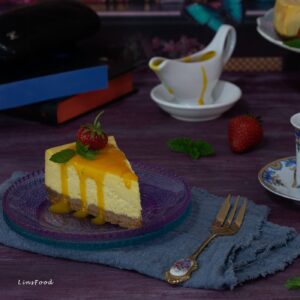
Eggless Mango Cheesecake Recipe
So our eggless mango cheesecake follows the same pattern, it has the same huge amount of cheese. However, these are the changes:
- Dropped the evaporated milk.
- Halved the buttermilk.
- Used canned mango pulp to replace the liquid above.
- Increased the plain flour and cornflour to 3 tablespoons each.
Super easy, really.
Fresh Mango or Canned Mango Pulp?
Initially, I thought fresh mango. In fact, my reply to one of the comments on the eggless vanilla cheesecake says to use fresh mango.
However, it occurred to me that canned mango pulp was a better bet, as then, one could make it out of season. And you know what, it was just as well, because when my order arrived from Ocado that first time, the fresh mangoes I’d ordered to garnish the cake with were completely unripe! Which explains the lack of in the photos!
The mango pulp from a can also has the added advantage of serving as a topping or sauce on the side. So a win-win, really.
Just be sure to get one with as little or no sugar added. And no other ingredients apart from the mango itself.

Cheesecake Topping
I prefer to leave my cheesecakes unadorned, even if they have cracks on them, but I do serve them with some sort of sauce on the side. To me, this allows one to fully appreciate the flavour of the cake itself, if one wanted to.
And that’s what I’ve done here; just drizzled the leftover mango pulp from the can when serving.
You could do the same, or you can pour the leftover COLD mango pulp all over your cold cheesecake, just before serving. Let it drip on the sides like a drip cake. As your eggless mango cheesecake will need to be kept in the fridge, the mango pulp will be perfectly fine.
Can Half Fat Cream Cheese be used to bake Cheesecake?
Absolutely! And the good news is, you don’t have to compensate for the reduction in fat by adding anything else. Your cheesecake will be just as delicious, with much less fat!
Water Bath for Cheesecakes
Call me lazy but I can’t be bothered with water baths when baking cheesecakes, unless I’m baking them for clients. The odd crack on the surface don’t bother me, if the cake is for the family.
However, if you prefer a pristine smooth eggless mango cheesecake top, by all means, bake your cheesecake with an oven proof dish filled with water, on the lowest shelf.
When the cheesecake is done, leave the water in the oven as the cake cools down with the door ajar.
ps: overbeating your cheesecake encourages cracks.
Cheesecake Base
Whenever I make cheesecakes, I have 3 types of biscuits that I typically use to make the base: digestives, plain crackers and ginger biscuits.
You can use anything you like. For our eggless mango cheesecake today, I went for the ginger ones the first time, as I thought they might be nice with the mango. They were pretty good.
Second time, I went with the digestive biscuits. This base, I thought was too rich for the mango cheesecake. The full flavour of the digestives competed with the cheesecake, so much so, that I ate it without the base.
So, as always, you can experiment with this as you like. Start out with something plain. As you get more adventurous, you could even crumble some dried pieces of mango into the base for a more mango-ey flavour. Although it may be a bit of an overkill, unless you’re #TeamMango, of course!
Right, I think we’ve covered all our, erm, bases. Shall we get our aprons on?
If you enjoy the recipe, drop me a comment and let me know. And if you are feeling like a star, don’t forget that 5-star rating!
If you make this recipe, post it on Instagram and tag me @azlinbloor and hashtag it #linsfood.
Lin xx
More Eggless Recipes on LinsFood

Eggless Mango Cheesecake
Equipment
- tabletop mixer or handheld beaters and a large bowl
- 9" (23cm) springform cake pan
Ingredients
The Base
- 200 g biscuits of your choice (see explanation in the post) (I used ginger biscuits)
- 100 g melted, salted butter
The Filling
- 900 g full fat cream cheese
- 250 g caster sugar (slightly finer than granulated)
- 125 ml buttermilk (or yoghurt or soured cream)
- 250 ml mango pulp from a can (or the equivalent of fresh)
- 3 Tbsp plain flour (all purpose)
- 3 Tbsp cornflour (cornstarch in the US)
Topping
- 125 ml mango pulp from the can, chilled (if fresh, cook it with 2 Tbsp of sugar, then chill)
Instructions
You must bake your cheesecake the day before you are planning to serve it.
- Preheat oven to 200˚C (390˚F/180˚C Fan).
- Grease, line and grease again, a 9 inch/23cm springform tin, including the sides.
The Base
- I like to do this in a food processor as it’s so much easier and quicker. Place the biscuits in the food processor and pulse to get fine crumbs.
- Add the melted butter (through the feed tube if you have one) and pulse until it’s all thoroughly mixed. You’ll end up with a mixture that looks like dark wet sand.
- Carefully press this biscuit mix onto the bottom of your greased pan, patting it and packing it flat with your palm.
- Bake in the oven for 10 minutes. When done, I like to keep it out to cool for 5 minutes on a wire rack (set the timer if you might forget!), then straight in the fridge while I get the cheesecake done.
The Filling
- In a tabletop mixer (or large bowl with handheld whisk), beat the cream cheese on medium-low until creamy for 1 minute. Add the sugar gradually during this minute in 2 additions.
- Next, add the two flours, scraping down the sides if you have to.
- Then add the buttermilk, whisking for only about 30 seconds.
- Finally, add the mango pulp and whisk till just mixed, about 20 seconds. Don’t over beat. Check for lumps, squash the bigger ones with a wooden spoon but don’t worry about it too much.
- Pour the mixture into the prepared tin gently.
- Double wrap the base of your cake pan in aluminium foil. This is to prevent the cake mix from dripping onto your oven flour if your cake pan isn't completely sealed.
- Bake at the initial high temperature for 20 minutes.
- Reduce the temperature to 110˚C(230˚F/90˚C Fan) and bake for another hour. When done, the cake should still have a wobble in the middle.
- Let it cool in the oven with the door slightly ajar for 1 hour.
- Then cool completely at room temperature on your kitchen counter.
- Finally, cover loosely with foil and refrigerate overnight.
The Next Day
- Carefully loosen the sides of your springform cake pan.
- Then very gently lift the cake off the base. Slide a butter knife very carefully under the baking paper on one side. You'll find the cake comes away very easily after that.
- Place on your serving dish or cake stand, and pour the chilled mango pulp all over.
Nutrition
Enjoyed this recipe? Add us to your Google Search Preferred Sources:



Hi Azlin, this recipe looks amazing, I’m very eager to try it. One question, the metric conversion does not convert the tablespoons, and US tablespoons are 3 teaspoons, whereas metric tablespoons are 4 teaspoons. Which is the correct amount please? Thank you
Hi Kylie, I had to do a Google search for what you asked, because I’ve always been a metric person and a tablespoon is 3 teaspoons to me. But a reader very recently told me that 1 Australian tablespoon is 4 teaspoons, and they use metric too. That’s the discrepancy.
So, the spoon conversions don’t change. Long story short: 1 tablespoon = 3 teaspoons.
Let me know how it goes!