

Enjoyed this recipe? Add us to your Google Search Preferred Sources:
Khoresh Bademjan or Bademjoon is a Persian Eggplant Stew with meltingly soft eggplants in a thick and tangy tomato based sauce, with pieces of meat to make it heartier.
Estimated reading time: 7 minutes

Khoresh Bademjan
In Farsi (the Persian language):
- khoresh = stew
- bademjan – eggplants
So, Eggplant Stew
Yellow split peas are also sometimes added, and the dish is known as Gheymeh Bademjan, where minced meat is used instead of chunks of meat. Our recipe today is with just eggplants and meat.
Khoresh Bademjan is one of my favourite eggplant dishes, and I love nothing better than to have it with a plate of steamed rice. Having said that, the crunch of falling apart tahdeeg is simply incredible with the soft, practically falling apart aubergines.
My kids are all vegetarian, so when I cook this Persian eggplant stew for us, I make a meat version, and one with just the eggplants and chickpeas. So a vegan khoresh bademjan, which is also very traditional in Iran.

Tart flavours in Persian Cuisine
As with many Persian khoresh, or stews, Khoresh Bademjan has an underlying tart or sour flavour. This is achieved by adding any of the following:
- sour grapes (ghooreh), which are young unripe grapes
- sour grape juice (abghooreh)
- dried limes (limoo amani, click to read more), or failing all that
- plain and simple fresh lemon juice
I tend to go with limoo amani, finishing off with a quick squeeze of lemon juice, because I love that touch of bitter that they lend to the stew.
If you have friends growing grapes, just ask them for a handful of the young unripe ones to make your khoresh!
Khoresh Bademjan Recipe
The recipe itself is pretty straightforward, but it takes just a little bit of effort and time, as we salt and then grill the eggplants first. Although these days, many eggplant varieties don’t need salting.
Traditionally, in Khoresh Bademjan, the eggplants are fried. You know eggplants are like sponges when it comes to oil, they soak up far too much my comfort. So the best thing to do is to grill (broil) them or bake them in the oven first. We shall be grilling (broiling) them.
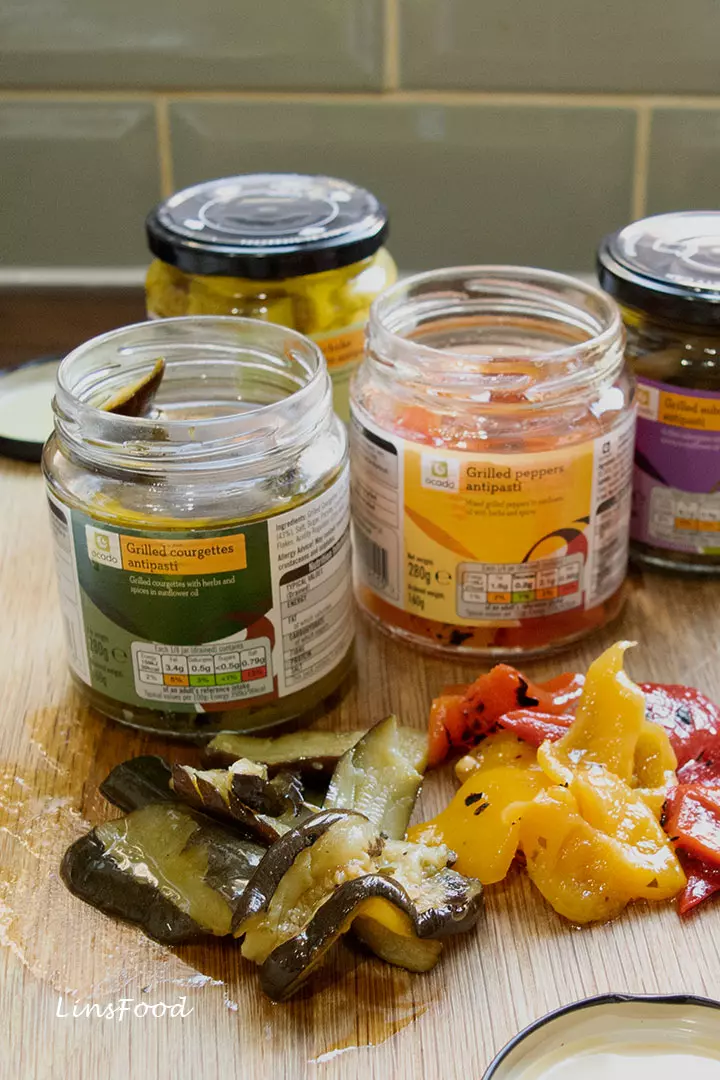
Or here is a cheat’s idea for the eggplants. Use shop bought pre grilled or roasted eggplants. These can be the plain old ones that are frozen, or the ones sold in jars as antipasto.
Like these jars below, the aubergine jar can just be seen in the back right. It doesn’t really interfere with the flavour of your khoresh. In fact, if anything, it deepens it.
What meat for your Khoresh?
Lamb is the preferred red meat in the Middle East. However, you can please yourself and go with what you like. I’m using small cubes of lamb here.
If you can get your hands on meat that’s on the bone, even better. Cut it up into bitesize pieces, but add the bone to the khoresh for added flavour.
And, you could even go with meatballs, which in my experience, makes it very attractive to kids!
Leg of lamb or shoulder of lamb is best for curries and stews, so those are the cuts you want to get, if you can.
What kind of eggplants should you use?
That’s completely up to you: large, medium, small, round – it depends on what you like and what you can get. For khoresh bademjan, I use medium eggplants, which slice up to about 5-6 pieces each; perfect for 4 – 6 people.
As mentioned above, these days, eggplants don’t really need to be salted anymore. However, I find that the extra step helps to season them and deepen the flavour.
Just bear in mind that many small eggplant varieties tend to be on the bitter side, so they most certainly need salting for a good 30 minutes.
Other Ingredients


Limoo Amani (Dried Persian Limes)
Click here to read more. Dried limes, whether brown or black are a very popular ingredient throughout the Middle East and have various names, depending on where you are or where the limes are from.
To use them, whether in today’s khoresh bademjan or any other stew, you simply crack them with the back of a knife to release the flavour, and add them to stews as they are. They soften upon cooking and become part of the stew’s filling.
Substitute: lemon juice, sumac, sour grapes, sour grape juice
Liquid Saffron (Bloomed Saffron)
Click here to read more, learn how to make it, and also for my YouTube video.
When you only soak the saffron in water, you are not utilising everything that this potent ingredient has to offer. You get the aroma, the flavour and the colour but the very substance of the saffron, to me, remains elusive when you leave it whole.
So how do we get to the inner beauty and magic of saffron and how do we make liquid saffron?
Easy, we crush those little guys in a pestle and mortar first, with just a tiny pinch of salt or sugar to aid the grinding, then we soak it in water.

Vegetarian Khoresh Bademjan
Is pretty easy to do. Half the time, when I’m cooking this for clients, I am asked to do one of each dish, meat version, and vegetarian version.
To make a vegetarian khoresh bademjan, just omit the meat, and add yellow split peas instead, which are traditional in this recipe, as mentioned above.
Use about 1 cup of yellow split peas, and follow the recipe below, adding the peas when you are meant to add the meat. Cook the peas for 30 minutes, then add the eggplants and finish up.
Yellow split peas do not need soaking.
That’s it, I hope you enjoy the recipe. If you are a fan of eggplants, you sure will!
Let’s get our aprons on!
More Persian Recipes on LinsFood
And with Nowruz, the Persian New Year coming up on the first day of spring, if you fancy more Persian recipes, check out the Middle Eastern and North African page, for must have recipes. Including Doogh, a traditional yoghurt drink served with meals, that’s also know as Ayran.
If you’re thinking along the lines of Ramadan recipes, you’ll find many on the Ramadan Recipes page, like this very comforting Haleem recipe.


Images by LinsFoodies


If you like the recipe, don’t forget to leave me a comment and that all important, 5-star rating! Merci!
And if you make the recipe, share it on any platform and tag me @azlinbloor, and hashtag it #linsfood
Noushe jan | نوش جان
Lin xx

Khoresh Bademjan Recipe (Persian Eggplant Stew, خورش بادمجان)
Equipment
- Knife
- Chopping board
- large bowl
- side plate
- a can of food to weigh the eggplants down
- saucepan
- ladle
Ingredients
The Eggplants
- 3 eggplants aubergines
- 1 Tbsp salt
- 1 lemon
Everything Else
- 2 Tbsp olive oil
- 500 g lamb, in bite size pieces (or beef) leg or shoulder cuts are best for stews
- 1 large onion chopped
- 1 small clove garlic finely chopped
- 1 tsp turmeric
- 2 Tbsp concentrated tomato paste
- 200 g canned chopped tomatoes
- 250 ml water
- 1 Tbsp liquid saffron pinch of saffron, ground or crumbled, then soaked in 1 Tbsp hot water
- ½ tsp salt
- 1 limoo amani OR substitute with the juice of 1 lime OR 1 tsp sumac
- freshly ground black pepper
- a small amount of chopped parsley optional
Instructions
Let's Prep the Eggplants
- Get a large bowl and fill it with cool tap water. Add 1 Tbsp of salt in and squeeze the juice of ½ the lemon.1 Tbsp salt, 1 lemon
- Peel the eggplants. Then slice them into long pieces, about 1cm (just under ½in) thick. You'll get about 5-6 pieces per eggplant.3 eggplants

- Place the sliced eggplants in the bowl of water. Place a small saucer on the eggplants and weigh down with a can of food, so all the eggplants are submerged in the salted, lemony water. Leave for 20 minutes. While the eggplants are soaking, let's get the meat going.


Let's start the Cooking
- Heat 1 Tbsp of olive oil on medium high heat, and sauté the chopped onions for 2 minutes.2 Tbsp olive oil, 1 large onion
- Add the garlic and turmeric and stir for 20 seconds.1 small clove garlic, 1 tsp turmeric
- Add the lamb and stir vigorously, coating it with all those onions. Do this for 3 minutes, to brown the lamb slightly.500 g lamb, in bite size pieces (or beef)
- Add the the tomato paste, chopped tomatoes, water and saffron water in. Stir and bring it to a boil.2 Tbsp concentrated tomato paste, 200 g canned chopped tomatoes, 250 ml water, 1 Tbsp liquid saffron
- With the back of a knife, pound the limoo amani (dried lime), so that it breaks up into 2-3 pieces. Scoop all this up and add to the stew. Don't worry, the lime will soften and be perfectly edible.Once the stew has come to a boil, reduce the heat right down and simmer for 1 hour or until the meat is just cooked. It will still be cooking for another 20 minutes with the eggplants, so don't overcook it at this stage.1 limoo amani
Back to the eggplants
- While the meat is cooking, let's attend to the eggplants. Rinse and pat dry the eggplants. Using a pastry brush, lightly brush each eggplant with olive oil and place under the grill (broiler) on high.Grill for 15 minutes, flipping them halfway through. Set aside until the meat is ready.

Finishing cooking the Khoresh
- When the meat is done, add the eggplants to the stew, bring back to a boil, then lower the heat and simmer for 20 minutes, until the eggplants are fully cooked and soft.
- Check the seasoning, and add more salt if you think it needs it. Be careful when you stir the salt in, don't break up the super soft eggplants.½ tsp salt
- Add some freshly ground black pepper and top with parsley if you like, and serve with some plain white rice, or some Saffron Rice.a small amount of chopped parsley, freshly ground black pepper

Notes
Nutrition
Enjoyed this recipe? Add us to your Google Search Preferred Sources:


Why peel the eggplants ?
Madel, in this traditional recipe, the eggplants were/are peeled for 2 reasons:
1. eggplants used to be a bitter (therefore the salting), and removing the skin would ensure that any lingering bitterness is disposed of.
2. The long cooking time allows the eggplants to fall apart in the khoresh. Without the skin, they practically dissolve into to sauce.
You don’t have to peel them if you don’t want to. I shall update this old post soon with that information. I hope that helps.
Hello! I’m just wondering what cut of lamb you used for this dish? Thank you!
Hi Dimity, leg or shoulder of lamb is best for this (or any stew). The bigger the cut pieces, the slightly longer the cooking time.
Been wanting to try a recipe using eggplant and this one is so good and flavorful!
Thank you, Linda, I’m so pleased you liked it.
Love eggplant based dishes.. be it curries, fritters or the dips.. this one sounds so flavourful.. would love to dig into the vegetarian version with steamed rice.. wonderful share..
Love eggplant and I am loving this Persian dish of yours with and without meat, able to satisfy both the world. The dish is very tempting and I am sure to enjoy this with some rice or even my daily roti.