Enjoyed this recipe? Add us to your Google Search Preferred Sources:
This homemade kashk recipe is going to be your next best friend, allowing you to make countless Persian and other Middle Eastern dishes that call for it.
Estimated reading time: 7 minutes

What is Kashk?
Kashk, to put it in the simplest terms, is a tangy fermented dairy product. It’s creamy, salty and rich in umami notes, a little like goat’s cheese. It is a much loved ingredient in Iran, with related preserved dairy products found across the Middle East and Central Asia.
You will also find kashk sold as dried fermented discs. These discs are soaked or ground and mixed with water before being used.
Is Kashk the Same as Jameed, Kurut, Kishk and Tarhana?
You’ll often see kashk grouped together with various fermented or dried foods from the surrounding region, including:
- jameed
- qurut or kurut
- kishk
- chortan
- tarhana
They are all part of a much wider tradition of preserving dairy, but they aren’t simply different names for exactly the same ingredient.
Jameed, strongly associated with Jordan and Palestine, and qurut or kurut from Central Asia and the Turkic world are closely related dried dairy products, although the milk, salting, drying and production methods can differ.
Kishk and tarhana are a little different again. Many versions contain wheat or another grain as well as fermented dairy, so they shouldn’t automatically be treated as interchangeable with Iranian kashk.
What is Kashk made of?
Kashk is what it’s called in Iran, and the word itself has a very long history. Earlier foods known by the name could include fermented grains, but modern Iranian kashk is primarily a fermented dairy product.
Traditionally, Iranian kashk was made using doogh, the fermented liquid left after yoghurt or soured milk was churned to separate the butter. The doogh was cooked and strained, leaving concentrated curds that could then be dried for longer storage.
If you like, you can read more about that, and get the recipe for for doogh here.

How to Make Homemade Kashk
Edit, August 2026: I no longer leave the yoghurt to stand at room temperature before making the kashk, as I’ve found it really doesn’t need it. So, if you’ve used my recipe before, you’ll notice that change in the method below.
Homemade kashk is so much better than anything you can buy in a carton. It has a fresher flavour, and you can control exactly how thick and salty you want it.
You can easily make kashk at home with yoghurt, water and a little salt. This is a practical homemade version rather than the old traditional method of starting with doogh.
This is what we’ll be doing:
- Start with full-fat Greek yoghurt, preferably one with a good tang to it.
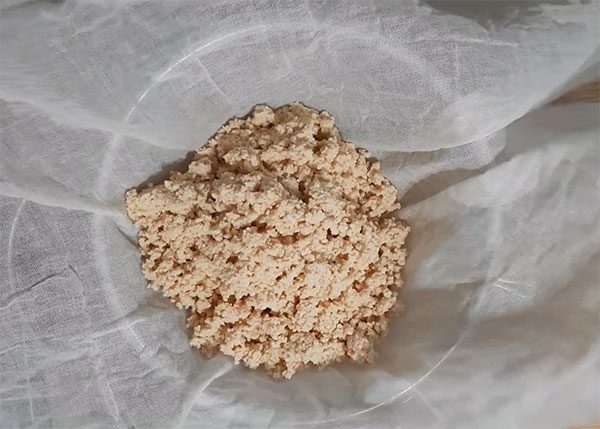
- Simmer the yoghurt and water for about 2–2½ hours. It will split into curds and whey at this point. Most of the whey is then cooked off, leaving behind the curds.
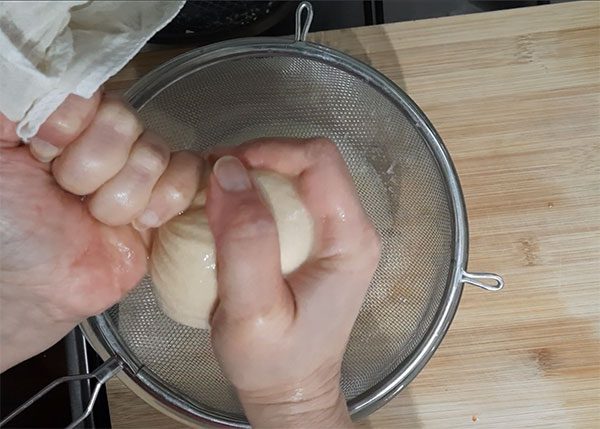
- Drain the curds to get rid of excess moisture.
- At this point, you can mix it with water and salt in a blender and use as required, or store as is.
Homemade Kashk in Photos




How Long Does Homemade Kashk Last?
Homemade kashk will keep in the fridge for up to 2 days, whether stored in its reduced form or after blending with water and salt. If you’re not going to use it within that time, I recommend freezing it.
How much water you use to blend homemade kashk depends on your recipe. Some may call for a runny kashk, while others will require a thick dollop, especially when used as a garnish.
You can also freeze it. Again, you can do this before or after blending it with water. My preferred way is to freeze it in its grain form, in ice cube trays, as you can see in the image. That way, I can use as much or as little as I need, without any leftover waste.
How to Use Kashk
Kashk can be used in several different ways:
- as a garnish or topping
- to thicken soups and stews
- in marinades
- as a flavour enhancer
In some ways, kashk is used as you would use soured cream or crème fraîche in savoury recipes.
It’s particularly well known in Persian dishes such as ash reshteh and kashk-e bademjan, where its sour, salty flavour is very much part of the finished dish.
Kashk Substitute
If you desperately need to have some kashk and don’t have the time to make it, here’s a good substitute.
You can use the same amount of crème fraîche or soured cream as the recipe calls for but grate in a tiny amount of goat’s cheese or Parmesan to up the umami factor. Say about 1–2 tablespoons of cheese for every measuring cup of kashk (metric – a cup that takes 250 ml liquid).
It won’t taste exactly the same, naturally, but it’ll give you some of that tangy, savoury quality that kashk brings to a recipe.
And now, let’s get our aprons on.
If you enjoy the recipe, drop me a comment and let me know. And if you’re feeling like a star, don’t forget that 5-star rating! Merci!
If you make this recipe, post it on Instagram and tag me @azlinbloor.
Lin xx
More Middle Eastern Ingredients


Homemade Kashk Recipe (Persian Fermented Yoghurt)
Equipment
- 1 large glass bowl
- 1 large saucepan
- 1 ladle
- 1 Large sieve
- 1 muslin or cheesecloth (click to see the one I use, from Amazon)
- blender or chopper
- container/ice cube tray to store
Ingredients
- 900 g full fat Greek yoghurt this is 2 tubs of 450g in the UK
- 1 litre water
- ½ – 1 tsp salt this is only for blending
Instructions
Making the Kashk
- Pour the yoghurt and water into a thick based saucepan and bring to a simmer on medium heat.

- Reduce the heat to medium-low and leave to simmer for about 2 – 2½ hours, stirring about 2-3 times.Your mixture will start to separate into curds and whey, and gradually reduce.


Draining the Kashk
- Wash and dry the large bowl you used earlier and top it with a muslin covered sieve. Double the muslin if it's too thin.
- Pour the dry-ish kashk grains onto the muslin to drain.
- Now wait for it to cool down to touch, so you don't burn your hands. Gather the corners of the muslin and wrap the kashk up and squeeze the excess whey.
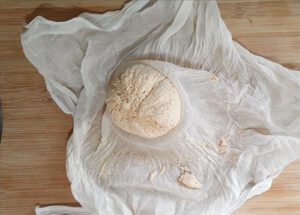
- Hang the muslin wrapped kashk to drain. I do it over the sink, on my tap.




Transforming Dry Kashk to Liquid Kashk
- Unwrap the kashk and gently crumble it. Depending on how dry it is, it may be quite hard, so give it a knock with the back of a knife to loosen it first.
- To transform this dried kashk grains into liquid, add enough water and salt to get a creamy, tangy liquid. How much you use depends on the recipe it's for. Start with a pinch of salt if making a small amount, and work your way up.

To Store Homemade Kashk
- This liquid kashk can now be frozen for up to 3 months or kept in the fridge for a week. Use any freezer proof container, I love ice cube trays for this.
- I also freeze just the grains in ice cube trays. Wrap tightly with cling flim, and freeze for up to 3 months.To use the frozen kashk, just defrost for an hour, depending on the amount.


Nutrition
Enjoyed this recipe? Add us to your Google Search Preferred Sources: