Enjoyed this recipe? Add us to your Google Search Preferred Sources:
Sumac is a deep red, tangy spice made from the dried fruits of Rhus coriaria, widely used in Middle Eastern and Mediterranean cooking. It’s an essential ingredient in many dishes, including za’atar, fattoush and Palestinian musakhan, where it adds a distinctive sourness and beautiful colour.
Estimated reading time: 23 minutes
Table of contents
- What Is Sumac?
- What Does Sumac Taste Like?
- Where Does It Grow?
- Culinary Traditions
- Types: Are They All Edible?
- Staghorn Tree in My Garden
- Edible Sumac vs Poison Sumac
- Harvesting and Processing
- How to Use Sumac in Cooking
- How Much Should You Use?
- Sumac Recipes on LinsFood
- How to Buy Good Sumac
- How to Store
- What Can I Use Instead of Sumac?
- FAQs
- Final Word
What Is Sumac?
Sumac is a spice made from the dried, ground fruits of plants belonging to the genus Rhus. The one we’re interested in for Middle Eastern cooking is Rhus coriaria, also known as culinary sumac, Sicilian sumac and tanner’s sumac.
It’s a deciduous shrub or small tree belonging to the Anacardiaceae family, which also includes pistachios, cashews, mangoes and mastic. Some rather illustrious relatives there, although there are also members of the family that we’d be better off keeping away from, as we’ll discover later.
The fruits grow in dense clusters, turning reddish as they ripen. Although we generally call them berries, they’re technically drupes, meaning they contain a hard stone or seed inside.
Once harvested, the fruit is dried and processed into the coarse, reddish-purple spice we know as sumac. You’ll occasionally find whole dried sumac berries sold in specialist food shops, although ground sumac is far more common and, for most of us, considerably more convenient.
It’s used both during cooking and as a finishing spice, and unlike cumin or coriander, it doesn’t need to be toasted or heated before use.
What Does Sumac Taste Like?
Sumac is sour. , and that’s precisely why we use it.
You’ll often see its flavour compared to lemon juice, which is fair enough, but I don’t think the comparison quite does sumac justice. There’s a definite fruity quality to it, along with a slight earthiness and a rather pleasant astringency, which leaves a faintly drying sensation in the mouth.
If you’ve ever bitten into a particularly sharp green apple, you’ll recognise something of that mouth-puckering effect. That’s partly down to malic acid, one of the organic acids found in sumac.
There are also tannins present, which contribute to its astringency.
One of the advantages of sumac is that it gives you acidity without adding liquid, something that’s especially useful when you’re working with spice rubs, bread toppings or dishes where you don’t want to introduce any more moisture.
The strength varies depending on the origin, age and processing of the spice, and whether it’s been mixed with salt.
I only ever use Palestinian sumac in my cooking, as I’ve found it has excellent flavour and colour. Naturally, there are good products from elsewhere too, but that’s my preference.
Is Sumac Spicy?
No, not in the hot sense of the word.
Although we call it a spice, sumac doesn’t contain the sort of heat you’d find in chilli flakes or cayenne. Its main characteristic is sourness, with perhaps a faint peppery note in some varieties.
So if you’re avoiding hot food, there’s no reason to avoid sumac. Unless, of course, you don’t like anything sour, in which case we may have a problem.
Where Does It Grow?
Rhus coriaria grows naturally across a surprisingly large geographical area, from parts of the Mediterranean and North Africa through western Asia, extending as far east as Afghanistan.
Its native range includes parts of southern Europe, Türkiye, Palestine, Lebanon, Syria, Iraq, Iran, the Caucasus and North Africa, among other places.
The Royal Botanic Gardens, Kew provides a detailed botanical distribution of the species, if you’re interested in the geography.
Sumac tends to favour sunny, well-drained conditions and can often be found growing on dry hillsides, rocky slopes and open ground. It’s a fairly hardy plant in suitable climates, which helps explain its widespread presence in the Mediterranean landscape.
Today, culinary sumac is grown and harvested in several countries, including Türkiye and Iran, while the Levant has a long tradition of using both cultivated and wild sumac.
And although it’s particularly associated with Middle Eastern food, it would be quite wrong to suggest that sumac belongs to one country or another. Like so many ingredients, its story crosses borders, cultures and centuries.
Sumac in the Ancient World
The word sumac came into English through French and medieval Latin, ultimately tracing back to the Arabic summāq, with older Semitic connections to the colour red.
Sumac was known in the ancient Mediterranean world, where it was valued for its sour flavour as well as its medicinal and astringent properties.
The Greek physician Dioscorides discussed the plant in De Materia Medica, his first-century work on medicinal substances, which gives us an indication of just how long sumac has been recognised and put to use.
Historically, it appeared in various traditional remedies. As a culinary ingredient, sumac provided a useful source of acidity, particularly in regions where sour flavours were an important part of the local food culture.
And while we tend to think immediately of lemons when we want something tart, cooks have always had other options, from fermented ingredients and sour fruits to vinegar, tamarind and sumac.
Sumac and the Leather Trade
Now, here’s something you may not know.
For centuries, sumac was an important ingredient in the leather tanning industry, especially in southern Europe. Its leaves contain high levels of tannins, which were used to process animal hides into leather.
This is where the name tanner’s sumac comes from; the same sumac used in Middle Eastern cooking.
Sicily became particularly important in the cultivation and export of sumac, especially during the nineteenth century, when its tannin-rich leaves were highly valued by European leather manufacturers.
In fact, the crop was important enough for the United States Department of Agriculture to publish an entire report in 1880 on sumac cultivation in Sicily and its preparation for international markets.
Imagine that. An entire government report devoted to the same plant whose fruit we now sprinkle over our hummus, although back then it was the leaves they were interested in.
The plant was also used in dyeing, with different parts producing various colours. It wasn’t just the fruits that were useful, either; the leaves and bark were valuable commodities in their own right.
It’s a good reminder that plants which we regard primarily as culinary ingredients today often had quite different roles in the past.
Culinary Traditions
Sumac has a particularly strong presence in the cuisines of the Levant, Türkiye, Iran, Iraq and neighbouring regions, although how it’s used varies considerably.
Sometimes it’s sprinkled over finished food, much as we might use black pepper. At other times, it’s added in generous quantities during cooking, becoming one of the principal flavours of the dish.
It’s also used to make sour infusions and forms an important part of several spice blends.
And this is where I think the usual description of sumac as a garnish does it a great disservice. There’s a whole world of cooking beyond that little red flourish on hummus.

Sumac in Palestinian Cooking
Perhaps one of the best-known Palestinian dishes featuring sumac is musakhan, a wonderfully satisfying combination of chicken, onions, olive oil and sumac, traditionally served over taboon bread.
Musakhan is closely associated with the Palestinian olive harvest, and the generous use of olive oil is central to the dish. The onions are slowly cooked until soft. They are then flavoured with plenty of sumac, which provides the tartness needed to balance their sweetness and the richness of the oil.
The chicken and bread complete the dish, and it’s a glorious example of how a relatively small number of ingredients can produce something so full of flavour.
Another Palestinian dish that deserves far more attention is sumakiyyah, also written as sumaghiyyeh, a traditional stew particularly associated with Gaza City.
Made with sumac, chard, chickpeas, meat, tahini and aromatics, it’s an old dish with deep cultural significance, traditionally prepared for celebrations and family occasions, including Eid, weddings and other gatherings.
I’ve written quite extensively about sumakiyyah in my recipe post, including its appearance in the medieval Arabic cookbook Kitab al-Tabikh.
In this dish, sumac provides the underlying sourness, often extracted into liquid before being added to the stew. It isn’t just there for colour or a little extra flavour; the dish is named after it, after all.

Sumac in Za’atar
Another very familiar use for sumac is in za’atar, the famous Levantine herb and spice blend.
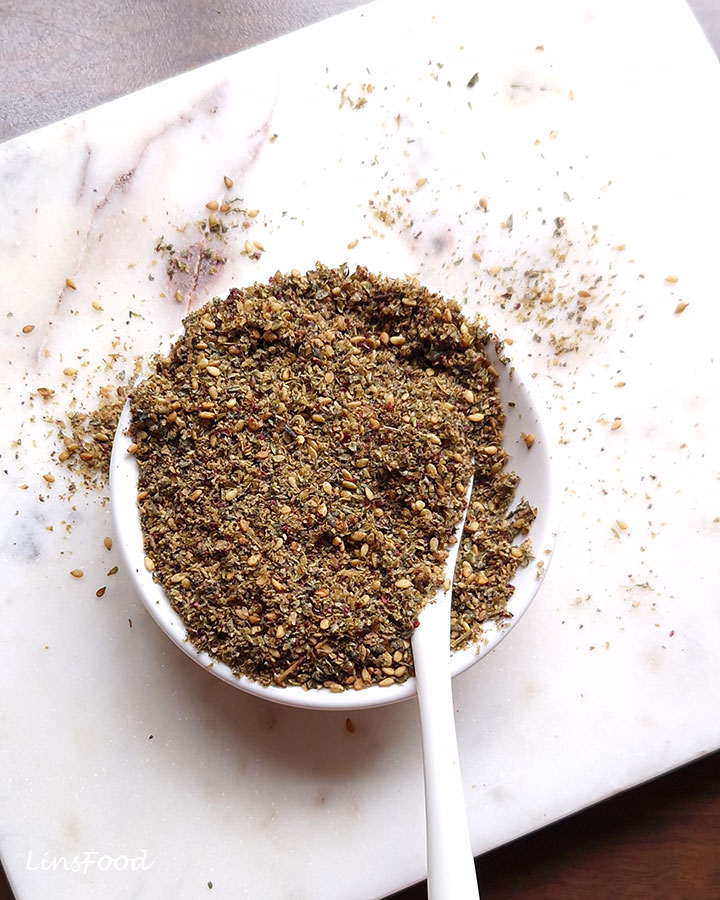
As I’ve explained in my za’atar article, the word itself refers both to the aromatic herb and to the seasoning made with its dried leaves, sesame seeds, sumac and salt.
The proportions vary from place to place. But the sumac provides the sour element that balances the herbs and toasted sesame seeds.
I love making my own za’atar, using homegrown Origanum syriacum when I can. Besides the satisfaction of growing and drying the herb myself, I get to control the proportions, particularly the sumac and salt.
And once you’ve made za’atar (or bought), the obvious next step is manakeesh, those wonderful Levantine flatbreads topped with za’atar and olive oil.
Fresh from the oven, they’re rather difficult to resist.
Turkish and Persian Cooking
In Turkish cooking, one of the most common ways of using sumac is with onions. Thinly sliced onions are tossed with the spice, often with parsley and a little salt, then served alongside grilled meats and kebabs.
Sumac is also used in salads, where its tartness works particularly well with tomatoes, cucumbers and fresh herbs.
I use it in my Turkish Shepherd Salad, even though the basic dressing is simply olive oil and lemon juice. I’ve had it served with sumac in Türkiye, so why not?
In Persian cooking, sumac is a familiar accompaniment to kebabs, particularly when served with rice, grilled tomatoes and onions. It’s often sprinkled over the meat at the table, allowing everyone to add as much or as little as they like.
And once you start noticing how sumac is used in different cuisines, you’ll realise that it has a much broader culinary life than its recent popularity as a finishing spice might suggest.
Types: Are They All Edible?
There are numerous species of sumac, and several have edible fruits, although they aren’t necessarily used in the same way.
For culinary purposes, it’s worth knowing about a few of them.
Staghorn sumac is native to North America and is widely grown as an ornamental tree, including here in Britain.
It’s easily recognised by its fuzzy red fruit clusters and hairy young stems, the latter being responsible for the name staghorn, as they resemble a stag’s antlers.
The fruits are edible when correctly identified and are traditionally used to make a refreshing, tart drink, often called sumac lemonade.
It’s not the same species as the commercial Middle Eastern spice, although the fruits of both have a sour flavour.
- Rhus coriaria – The Popular Culinary One
This is the species traditionally used to make the ground sumac sold in Middle Eastern and Mediterranean food shops.
Also called Sicilian sumac or tanner’s sumac, Rhus coriaria produces clusters of reddish fruits, which are dried and processed into the tart spice we use in cooking.
When a Middle Eastern recipe calls for ground sumac, this is generally what it means. - Rhus typhina – Staghorn
Staghorn sumac is native to North America and is widely grown as an ornamental tree, including here in Britain.
It’s easily recognised by its fuzzy red fruit clusters and hairy young stems, the latter being responsible for the name staghorn, as they resemble a stag’s antlers.
The fruits are edible when correctly identified and are traditionally used to make a refreshing, tart drink, often called sumac lemonade.
It’s not the same species as the commercial Middle Eastern spice, although the fruits of both have a sour flavour. - Rhus glabra – Smooth
Another North American species, smooth sumac also produces clusters of red fruits, traditionally used in drinks and other food preparations.
As the name suggests, its branches are smoother than those of staghorn sumac. - Rhus aromatica – Fragrant
Fragrant sumac is another North American species with a history of traditional food and beverage use.
Fragrant sumac grows as a smaller shrub and looks quite different from staghorn sumac. Middle Eastern cooks generally use Rhus coriaria to make the familiar ground spice instead.
Staghorn Tree in My Garden
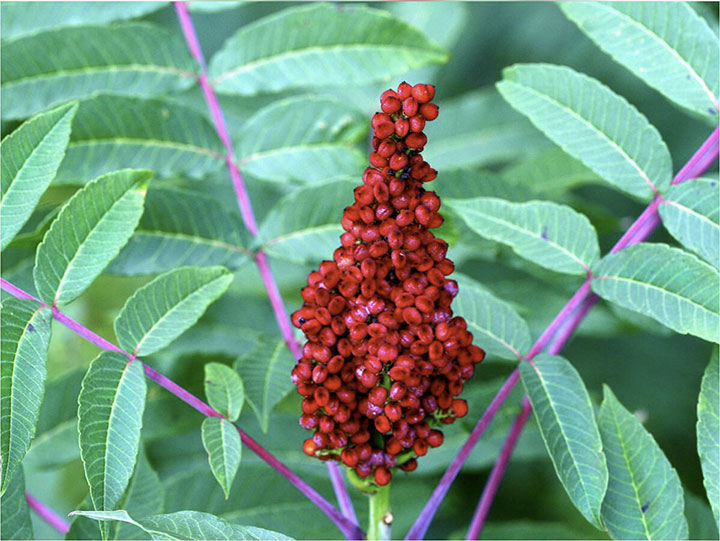
I have a staghorn sumac (Rhus typhina) growing in my garden, so I thought I’d include a photograph of it here.
It’s a lovely ornamental tree, particularly in autumn when the foliage turns shades of orange, red and yellow. The fruit clusters are equally striking, with their upright, velvety appearance.
If you’re thinking of growing staghorn sumac – is that it can spread by producing suckers from its roots. So choose its position carefully. Unless you’re particularly keen on finding new sumac trees popping up everywhere!
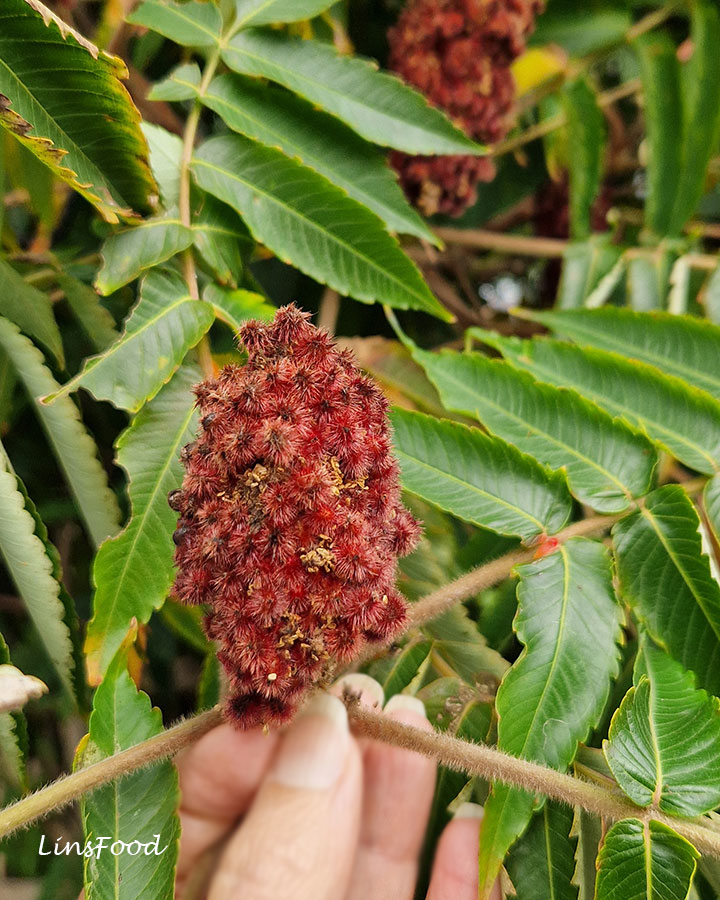
You’ll often come across photographs of this plant when searching online for sumac, particularly on stock photography sites and Canva. The trouble is that these pictures are sometimes used to illustrate the Middle Eastern spice, which is normally made from Rhus coriaria.
Just remember, both are edible species, but they aren’t the same plant.
Edible Sumac vs Poison Sumac
Now, before anyone decides to head into the nearest woodland armed with a basket, we need to talk about poison sumac.
The good news is that the culinary sumac sold as a food spice is edible and isn’t the same plant as poison sumac.
Poison sumac is Toxicodendron vernix, a different genus within the same wider plant family. It’s related to poison ivy and poison oak, and contains urushiol, an oily substance that can cause severe allergic skin reactions.
It should never be eaten or handled deliberately.
How to Tell Edible Sumac From Poison Sumac
There are some characteristic differences between the common edible North American sumacs and poison sumac:
- Fruit colour: staghorn and smooth sumac generally have red fruit clusters, while poison sumac develops pale, whitish or greyish fruits.
- Fruit arrangement: staghorn sumac has dense, upright clusters, while poison sumac’s fruits hang in looser, drooping clusters.
- Growing conditions: the poison variety typically grows in wet, swampy or boggy areas of eastern North America, while staghorn sumac prefers drier ground.
- Leaves and stems: staghorn sumac has toothed leaflets and hairy young stems, while poison sumac has smooth-edged leaflets.
While these are useful distinctions, they shouldn’t be treated as a complete foraging guide, and fruit colour alone isn’t enough to identify a plant safely.
And if there’s any doubt, leave it alone. Please.
Harvesting and Processing
Harvest culinary sumac in late summer or autumn, once the fruit clusters have developed their characteristic red colour. The exact timing depends on the climate and growing conditions.
The traditional process involves collecting the fruit clusters, drying them thoroughly, then crushing or grinding the dried fruits to separate the flavourful outer parts from the hard seeds and other unwanted material.
The mixture is then sieved to produce the coarse powder we recognise as ground sumac.
Different producers have their own methods, and the finished spice can vary in colour, texture and acidity.
Some also add salt, which is worth remembering when you’re following a recipe that calls for a generous quantity.
Can You Harvest Staghorn Sumac?
Yes, provided the plant has been positively identified as an edible species.
Harvest staghorn sumac when the fruit clusters turn fully red, ideally after a spell of dry weather, as heavy rain can wash away some of the sour compounds on the fruit’s surface.
To make a tart infusion, steep the fruits in cool water, then strain the liquid thoroughly to remove any fine hairs and other debris.
If you’re making this at home, proper identification is essential, as is avoiding plants growing in areas exposed to pesticides or pollution.
How to Use Sumac in Cooking
One of the nicest things about sumac is how easy it is to incorporate into everyday cooking. You don’t need to make a traditional Middle Eastern recipe to use it, although there are plenty of those worth making.
You can use sumac during cooking or add it at the end, depending on what you’re making. It’s particularly useful with rich, fatty foods, where its acidity helps balance the dish, but it works just as well with vegetables, grains and creamy dips.
Here are some ideas:
- Sprinkle it over dips. Hummus, labneh, mutabal, baba ganoush and yoghurt-based dips are all lovely with a little sumac. Add some good olive oil and chopped herbs, and you’ve got yourself a very respectable addition to the mezze table.
- Add it to salads. Sumac is an important ingredient in fattoush, but you can also use it in tomato and cucumber salads, chickpea salads, lentil salads and grain bowls. I particularly like it when there’s plenty of fresh parsley involved.
- Make sumac onions. Thinly slice a red onion and toss it with sumac, a little salt and chopped parsley. Leave for about 10-15 minutes, then serve with kebabs, grilled chicken, falafel or wraps. You can add lemon juice or vinegar if you want more acidity, although I suggest tasting the onions first.
- Use it with chicken. Sumac is excellent with roast or grilled chicken, especially when combined with olive oil, garlic and black pepper. My Sumac Chicken Traybake is a good place to start if you want something uncomplicated.
- Season fish and seafood. Try it with grilled fish, salmon or prawns. I like the way it brings acidity without the extra moisture of lemon juice, particularly when the fish is already seasoned with herbs and olive oil.
- Sprinkle it over potatoes. Roast potatoes, chips, wedges and potato salads can all benefit from sumac. Add it while the potatoes are still warm, along with salt and fresh herbs. It’s especially good with a yoghurt or tahini dressing.
- Use it with eggs. Fried eggs, boiled eggs, omelettes and shakshuka are all suitable candidates, particularly if you’re serving them with yoghurt, olive oil or bread.
- Stir it into yoghurt. Mix plain yoghurt with it, crushed garlic, olive oil and salt for an easy sauce. It’s lovely with grilled meats, roasted vegetables and rice dishes, and takes all of a couple of minutes to put together.
- Use it in marinades and dressings. Combine this deepy ruby spice with olive oil, garlic, cumin, allspice or other spices, depending on what you’re cooking. For dressings, you can use it alongside lemon juice or vinegar, adjusting the quantity to suit your taste.
- Add it to rice and grains. Sprinkle it over rice, bulgur, couscous or freekeh, particularly when serving them with grilled meats, vegetables or chickpeas.
- Use it in za’atar and on flatbreads. If you make your own za’atar, sumac is one of the ingredients you’ll want to get right. Mix the finished blend with olive oil and spread it over flatbread before baking.
- Try it with fruit. Watermelon, oranges and pomegranate can all take a little of this lemony spice, particularly in salads where you’re combining sweet and savoury ingredients. Start with a small amount and see how you like it.
How Much Should You Use?
That depends on the dish and the strength of your sumac.
For a small bowl of hummus or labneh, half a teaspoon may be sufficient, although there’s nothing stopping you from adding more.
For a salad dressing serving four, I’d start with about one teaspoon, then taste and adjust.
When using it in a marinade for chicken or lamb, you can be considerably more generous, perhaps one or two tablespoons depending on the quantity of meat and the other ingredients.
Then there are dishes like musakhan and sumakiyyah, where several tablespoons may be required.
For example, my sumakiyyah recipe uses six tablespoons of it because the sourness is essential to the dish.
The most important thing is to taste your sumac before you begin, particularly if it’s a new brand. You may also need to adjust the salt in your recipe if your jar already contains some.
Sumac Recipes on LinsFood
If you’ve got a jar of sumac sitting in the cupboard and are wondering what to make with it, we’ve got so many recipes using this deep red spice on LinsFood.
Some use sumac as a main ingredient, while in others it’s there to complement the rest of the flavours.
- Sumac Chicken Traybake – an easy, flavourful traybake inspired by Palestinian musakhan. Perfect when you want dinner to be relatively fuss-free.
- Musakhan – traditional Palestinian sumac chicken with onions and olive oil, served over flatbread.
- Sumakiyyah – a traditional Palestinian sumac and chard stew from Gaza, with meat, chickpeas, tahini and aromatics.
- Fattoush – one of my favourite warm-weather salads, made with crisp vegetables, toasted or fried bread and a wonderfully tangy dressing.
- Turkish Shepherd Salad – a simple chopped vegetable salad with herbs and a dressing that includes sumac.
- Za’atar – my homemade Levantine herb and spice blend, which uses sumac alongside dried za’atar herb, sesame seeds and salt.
- Manakeesh – Levantine flatbreads topped with za’atar and olive oil, wonderful freshly baked.
- Mutabal – a smoky aubergine, yoghurt and tahini dip, finished with olive oil, herbs and sumac.
- Pumpkin Mutabal – an autumnal variation of mutabal, with roasted pumpkin bringing a lovely sweetness to the dip.
Enjoying this guide to sumac? Save it to Pinterest so you can find it again when you need it.
How to Buy Good Sumac
Sumac is now fairly easy to find in the UK, with most large supermarkets stocking it, although you’ll generally have a wider choice in Middle Eastern, Turkish and Persian food shops.
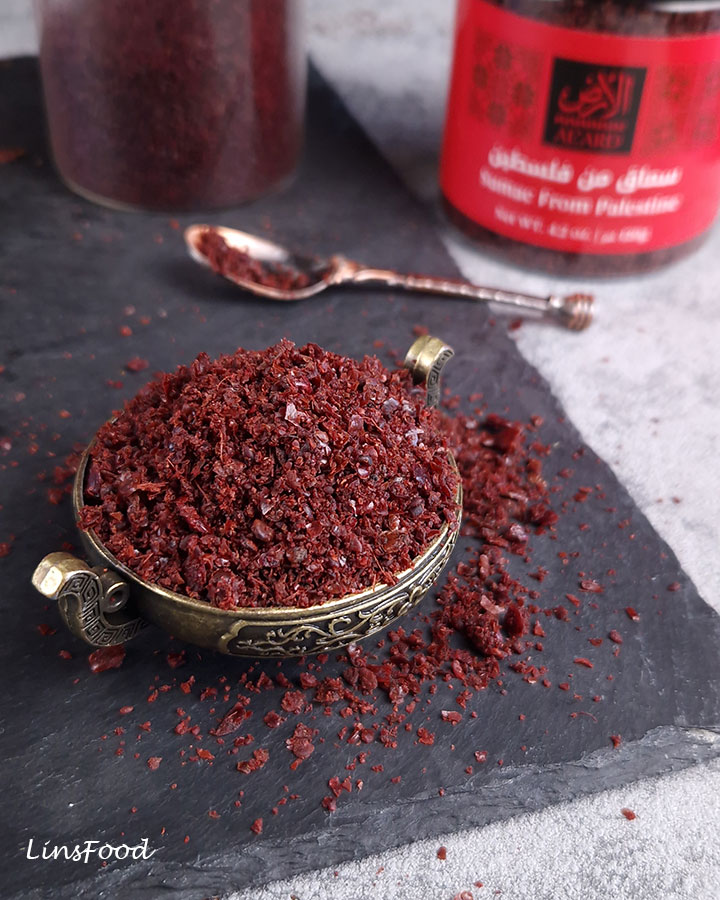
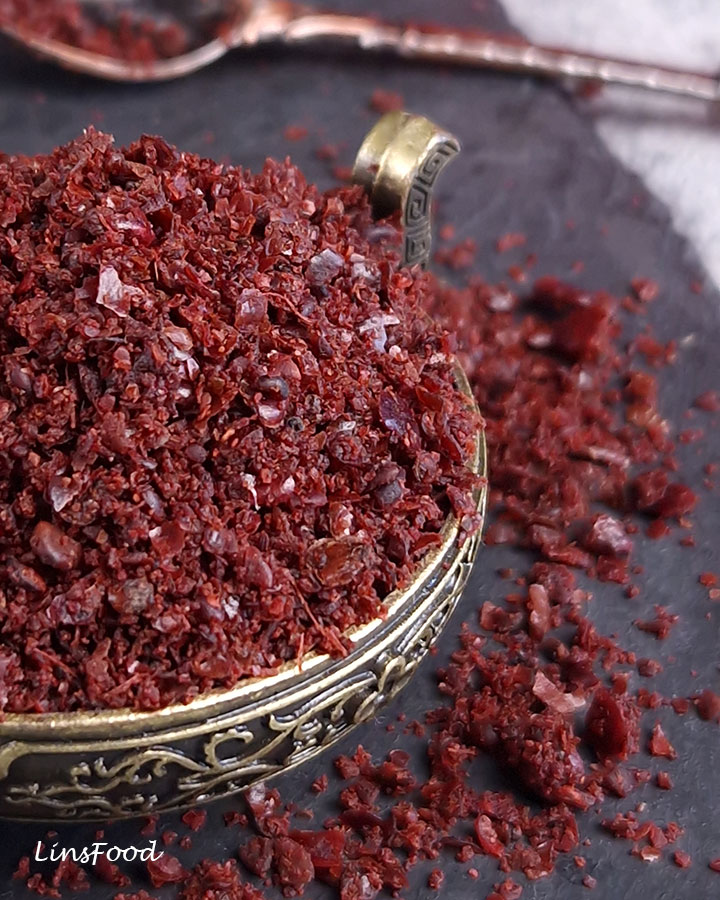
It also varies in texture. Some brands grind it into a fine powder, while others, like the Palestinian one you can see in my photographs, are considerably coarser, with little flakes of the dried fruit still visible. I prefer this coarser texture myself, although both are perfectly fine for cooking.
Look for a powder with a good, deep red or burgundy colour.
The colour can vary considerably, though, so don’t assume that a brighter red automatically means a better product.
What matters more is the flavour. Good sumac should have a pronounced tartness, with a pleasant fruity quality. If it tastes dull or barely sour, it may simply be old or of poor quality.
Does Sumac Contain Salt?
Some commercial brands contain added salt, while others sell the pure ground spice.
The amount can vary, so always read the ingredients list, particularly if you’re making a dish where sumac features heavily.
I prefer the salt-free version because it allows me to control the seasoning, but if the salted variety is all you can find, don’t worry. Just hold back on any additional salt until you’ve tasted the finished dish.
How to Store
Keep your sumac in an airtight container, away from heat, light and moisture.
A cool kitchen cupboard is ideal, although I wouldn’t store it right next to the hob, where repeated exposure to heat can gradually affect the flavour.
Like most ground spices, it will lose some of its potency over time, so I recommend using it within about a year for the best flavour.
This isn’t a strict expiry date, and properly stored, may remain usable for longer. But if you’ve had the same jar for several years and it no longer smells or tastes of much, I’d replace it.
What Can I Use Instead of Sumac?
There’s no exact substitute for sumac, but if you can’t get hold of it, there are a few alternatives, depending on what you’re cooking.
Lemon juice is the most obvious, particularly for dressings, marinades and sauces. It provides the acidity you’re looking for, although you’ll be adding liquid to the dish, which may not always be ideal.
Lemon zest can add a pleasant citrus aroma without extra moisture, but it won’t give you the same degree of sourness. You can combine zest with a little juice if the recipe allows.
Vinegar works well in dressings and marinades, although it has a different sharpness, so add it gradually.
Pomegranate molasses may work in some Middle Eastern dishes, particularly those where its sweet and sour flavour would complement the other ingredients. It’s much darker and sweeter, so don’t treat it as a direct replacement.
Tamarind can also provide sourness, especially in cooked dishes, but again, it brings its own distinctive flavour.
If sumac is only being used to add a little tartness, one of these alternatives should do the job.
However, for dishes like musakhan or sumakiyyah, where sumac is a defining ingredient, I’d strongly recommend using the real thing. The finished dish simply won’t be quite the same without it.
FAQs
Sumac spice is made from the dried fruits of edible sumac plants, most commonly Rhus coriaria. The dried fruit is processed into a coarse, reddish-purple powder with a distinctive tart flavour.
Sumac has a sour, fruity flavour with a slight earthiness and astringency. It’s often compared to lemon, although it has its own character and can be used both as a cooking ingredient and a finishing spice.
No. Sumac is a single spice, while za’atar is both the name of an aromatic herb and a seasoning blend commonly made with dried za’atar leaves, sesame seeds, sumac and salt.
Culinary sumac is edible, but poison sumac (Toxicodendron vernix) is a different plant containing urushiol, which can cause severe allergic skin reactions. Never eat or handle an unidentified sumac plant.
Yes. Ground culinary sumac is ready to use straight from the packet or jar. It doesn’t need cooking and can be sprinkled over dips, salads, grilled meats and other finished dishes.
Yes, in some recipes. Lemon juice is useful when you need acidity, while lemon zest can provide citrus aroma without adding much moisture. Neither is an exact substitute, particularly in dishes where sumac is a principal ingredient.
Pure ground sumac is naturally gluten-free. However, commercial blends may contain added ingredients, so always check the label if you’re cooking for someone with coeliac disease or gluten intolerance.
Yes, certain species can be grown in Britain, including staghorn sumac (Rhus typhina), which is commonly grown as an ornamental tree. This isn’t the same species as the culinary Rhus coriaria used for traditional Middle Eastern ground sumac.
You’ll find sumac in Middle Eastern, Turkish and Persian food shops, many larger supermarkets and online spice retailers. Look for good-quality ground sumac with a pronounced tart flavour, and check whether salt has been added.
Final Word
For something that looks like a rather unassuming pile of red powder, sumac has a lot going for it. It’s been part of Middle Eastern and Mediterranean food traditions for centuries, has an interesting history beyond the kitchen, and remains one of the most useful ways of introducing acidity into a dish.
And you really don’t need to be cooking anything particularly elaborate to appreciate it. A little sumac over some onions, a bowl of yoghurt or even your roast potatoes can be quite enough.
Of course, if you fancy something more substantial, I’d suggest starting with musakhan or my easy sumac chicken traybake, then perhaps working your way towards sumakiyyah.
Once you’ve got a decent jar in your cupboard, I suspect you’ll find plenty of other uses for it.
More soon,
Lin xx
Enjoyed this recipe? Add us to your Google Search Preferred Sources: