

Mahalabia (also spelled muhallabia, muhalabia, muhallebi, mahalabiya – and closely related to malabi) is the Middle East’s answer to a chilled milk pudding: softly set, lightly sweet, and scented with rose water or orange blossom water. It takes about 10 minutes on the hob, then the fridge does the rest.
If you like panna cotta but don’t want gelatine, this is your dessert.
Estimated reading time: 12 minutes
Table of contents
- What is Mahalabia?
- Origin of Mahalabia
- Muhallebi Ingredients
- What Milk to use?
- Cornflour (cornstarch) or rice flour?
- Can you make Mahalabia with Condensed Milk?
- How to serve Mahalabia
- Balsamic Strawberries for our Mahalabia
- Where to get rose water or orange blossom water?
- Mahalabia FAQs
- More Mahalabia Recipes on LinsFood
- More Middle Eastern Desserts
- Images by LinsFoodies

What is Mahalabia?
Mahalabia (muhallabia) is the Middle East’s chilled milk pudding – silky, lightly scented, and dangerously easy to make. It’s kind of like blancmange, panna cotta-ish, and best of all: no gelatine. You cook it for a few minutes, chill it, and suddenly you’ve got dessert.
You’ll find versions of this Arabic pudding all over the Middle East, with every country claiming it (as they should). If you like creamy, milky puddings, you’ll be very happy here.
Bonus: it’s a make-ahead dessert, which makes it dinner-party gold.
Origin of Mahalabia
Like so many beloved regional classics, mahalabia comes with a story (and a bit of rivalry).
One popular legend places it in Persia and links its spread into Arab cuisine to the late 7th century during the Umayyad Dynasty. The tale goes that a Persian cook served an irresistible milk pudding to the Arab general al-Muhallab ibn Abi Sufra, who loved it so much the pudding ended up bearing his name.
Then there’s the much less romantic, but very sensible point: the Arabic word for milk is halib (haleeb), so the name could just be pointing out the obvious… it’s a milk pudding.
Either way, we’re here for the pudding. The origin debate – we’ll ignore it while we keep eating.
Muhallebi Ingredients
This milk pudding really is the easiest thing to make. We have it so often at home that half the time, my kids are the ones making it.
Here’s what you need:
- milk
- evaporated milk or a little cream (I’ll explain why I love evaporated milk below)
- sugar
- cornflour (cornstarch in the US)
- rose water or orange blossom water
- ground cardamom (optional, but glorious)
- garnish: pistachios/almonds and (if you like) dried edible rose petals or rose syrup
The Recipe:
- make a paste with the cornflour
- mix the cornflour paste with both milk and the sugar, and gently heat
- cook for about 5 – 10 minutes
- take it off the heat and add flavouring (cardamom and whatever flower water or extract you’re using)
- leave to cool, then cover with clingfilm and place in the fridge to chill (minimum 4 hours)
- garnish just before serving
I told ya it was easy!
This Middle Eastern dessert can also be made a day ahead, in fact, overnight chilling (covered) gives the best result.
What Milk to use?
Fresh milk is traditional, and whole milk gives you the best texture and flavour.
But if you’ve been around LinsFood for a while, you’ll know I have a soft spot for evaporated milk in desserts. It adds richness without making the whole thing heavy, and it gives you that “how is this so creamy?” result with very little effort.
This recipe uses a mix of whole milk and evaporated milk for an indulgent but still surprisingly light mahalabia. I’ve also made it with semi-skimmed milk and semi-skimmed evaporated milk with very good results.
Cornflour (cornstarch) or rice flour?
If you want a smooth, silky mahalabia with that clean, custardy set, cornflour/cornstarch is the most reliable thickener and the one I recommend here.
Rice flour is also used in many homes and regions, and can be closer to older/traditional versions depending on where you’re eating it. But it does tend to give a slightly more textured mouthfeel. Some people love that; I don’t want it in my mahalabia.
Important label note, because it trips people up:
- Canada/Australia: “cornflour” can mean something else (more like finely milled cornmeal). If your box says corn flour (two words) and looks yellow, don’t use it. You want the white, powdery starch.
- UK: cornflour = cornstarch
- US: cornstarch

Can you make Mahalabia with Condensed Milk?
Absolutely. But reduce the sugar (or skip it), otherwise it’ll be far too sweet.
- 750 ml (3 cups) fresh whole (full fat) milk
- 250ml (1 cup) condensed milk (instead of the evaporated milk)
- omit the sugar
- ⇒ then follow the rest of the recipe as written
Mahalabia can also be made a day ahead, in fact, overnight chilling (covered) gives the best result.

How to serve Mahalabia
We make this for birthdays, summer parties, Ramadan, Eid, Nowruz… and for no reason at all.
Classic (and my favourite) ways:
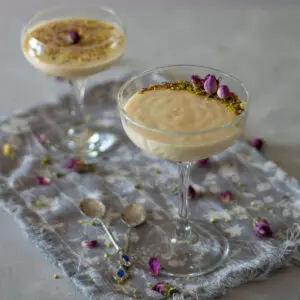
- crushed pistachios and/or almonds for crunch
- crushed dried edible rose petals for that musky floral hit
- a drizzle of rose syrup (dilute it slightly so it doesn’t take over)
Also excellent (not traditional, but delicious):
- fresh berries
- butterscotch
- caramel or salted caramel
- chocolate shavings, chocolate sauce, or a spoon of chocolate ganache
- shredded coconut (with or without raisins)
- crushed hibiscus petals for tart contrast
And yes, balsamic strawberries. Oddly perfect with the creamy, floral pudding.

Balsamic Strawberries for our Mahalabia
- 12 strawberries, quartered
- 2 Tbsp balsamic strawberries
- 1 tsp white sugar
- dash of freshly ground black pepper
Mix everything and leave to macerate for 30 – 60 minutes, stirring once or twice.
Spoon over chilled mahalabia just before serving.

Where to get rose water or orange blossom water?
They should be sitting next to the vanilla in the baking aisles of your supermarket. Failing which, online is the way to go. I prefer getting mine from the local multi ethnic store, as these will be of Middle Eastern or South Asian make.
If you shop on Amazon, these are the ones I use, click below to get them with my affiliate links:
Can’t get Orange Blossom Water or Rose Water?
I know some of you can’t get rose water or orange blossom water, and that’s perfectly fine.
Don’t flavour it or go with half a tsp of good quality vanilla extract or even almond extract in this recipe. Or leave the flavouring out completely and serve with some fruit.
Troubleshooting
My mahalabia is lumpy
You added starch to warm milk, or the paste wasn’t smooth. Always make a slurry with cold milk first.
My mahalabia is runny
It didn’t cook long enough for the starch to fully activate, or it hasn’t chilled long enough. Cook until it’s thick like custard, then chill at least 4 hours.
My mahalabia caught at the bottom
Heat was too high or the pan too thin. Next time, use a heavy-based pan and keep the heat medium-low once it starts thickening.
Dry skin on top
Cover while chilling (cling film touching the surface works best).
Make ahead and storage
This is a make-ahead dessert by design.
- Chill at least 4 hours; overnight is even better.
- Keep covered in the fridge for 3 – 4 days.
- Add toppings just before serving so they stay crisp.
Mahalabia FAQs
I first published this Mahalabia recipe in 2013. Here are some of the most common questions I’ve received over the years about mahalabia and muhallebi.
Mahalabia (also spelled muhallabia/muhallebi) is a chilled Middle Eastern milk pudding thickened on the hob, then set in the fridge. It’s silky like blancmange and has the panna cotta vibe – but without gelatine.
At its simplest: milk, sugar, a thickener (cornflour/cornstarch or sometimes rice-based thickeners), plus rose water or orange blossom water. Many versions also include cardamom and a nut topping.
They’re the same family of dessert. The spelling shifts by country and language, and small details (thickener, garnish, flavouring) vary, but the dessert idea is the same.
They’re closely related and often overlap. Malabi is frequently served with a syrup topping and can lean more “topped and sauced”, while muhallebi/mahalabia is typically a gently perfumed milk pudding finished with nuts. Naming changes by region, so expect crossovers.
Yes, but the texture can be a bit more rustic/less silky than cornstarch. If you want the smoothest spoonful, stick with cornstarch; if you like a slightly more textured pudding, rice flour can work.
Yes – and that’s exactly what this recipe does. Cornstarch (cornflour in the UK) gives a reliable set and a very smooth texture.
Absolutely. Use orange blossom water instead, a little vanilla, or leave it plain and let toppings do the work.
Rose water is the classic swap. If you don’t have either, use a little vanilla extract, or skip floral flavouring and top with fruit or a syrup.
Covered, it keeps well for 3 – 4 days. Add nuts and petals just before serving so they stay crisp.
It usually wasn’t cooked long enough to fully activate the starch, or it hasn’t chilled long enough. Cook until it’s thick like custard, then chill at least 4 hours (overnight is best).
Most often the starch wasn’t fully mixed with cold milk before heating. Make a smooth slurry with cold milk first, then heat gently while stirring.
This version is gluten-free because it uses cornstarch/cornflour. If you need strict gluten-free, check labels for certification.
More Mahalabia Recipes on LinsFood
I love playing with variations of traditional recipes. Below are 2 very different Mahalabia recipes on here. The first one uses the combination of coconut milk and palm sugar, a favourite South East Asian flavour combination.
And the second is a sexy mango and sumac combination. Sumac in a dessert? Totally works!

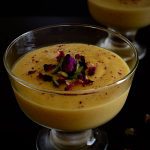
More Middle Eastern Desserts
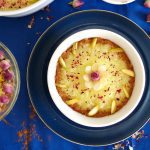
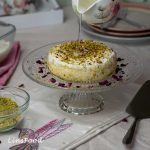

Images by LinsFoodies
Have you shared yours with me? Upload your photo on Instagram, Pinterest or Facebook and tag me @azlinbloor and use the hashtag #linsfood.
Not on social media? Email it to me!


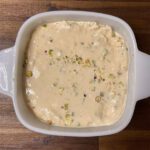
If you like the recipe, don’t forget to leave me a comment and if you’re feeling generous, a 5-star rating! Shukran!
And if you make the recipe, share it on any platform and tag me @azlinbloor.
Lin xx
Mahalabia Recipe – Middle Eastern Milk Pudding
Ingredients
- 500 ml fresh whole milk
- 500 ml evaporated milk
- 150 g white sugar
- 5 Tbsp cornflour cornstarch in the US
- 1 Tbsp rose water or orange water
- ¼ tsp ground cardamom or pound the seeds of 8 cardamoms in a mortar with a pestle
Garnish
Instructions
- Make a paste with the cornflour and about 3 Tbsp of the fresh milk.5 Tbsp cornflour, 500 ml fresh whole milk

- Combine this cornflour paste, both types of milk and the sugar in a heavy based saucepan or milk pan and stir to mix.500 ml evaporated milk, 150 g white sugar

- Bring to a simmer on medium heat, stirring it regularly. Don't whisk it, as that will create bubbles that you don't want. After about 5 minutes, you'll notice the milk mixture begin to thicken slowly with a thicker and smooth consistency.

- Lower the heat down slightly to medium-low and continue cooking and stirring for another 5 minutes until the muhallebi resembles thick custard.Now you need to be careful here as the milk can catch at the bottom of the pot if your heat is not low enough, or if the pan doesn't have a thick enough base. You don't want burnt milk or bits in your mahalabia! Just in case, do not scrape the bottom of the pan as you are stirring.

- When the mahalabia is as thick as custard, take it off the heat and add the rose/orange water (whatever you're using) and crushed cardamom seeds and stir.1 Tbsp rose water or orange water, ¼ tsp ground cardamom

- Pour into your chosen serving dishes or cups.

- Place in the fridge to cool for at least 4 hours. It will thicken when cold.If you are going to chill it overnight, cover the cups/dishes with cling film or saucers to prevent the Mahalabia from absorbing any smells but also to stop the surface from becoming dry.

- To serve, drizzle the rose syrup over it (if using) and sprinkle with nuts.2 Tbsp of rose syrup diluted in 2 Tbsp water, slivered/crushed pistachios or toasted almonds


Thank you we made this on the first day and it was thoroughly enjoyed by all. Making it again today! So easy yet so perfect for Iftar.
I’m so pleased to hear that! Thanks for letting me know!
Thanks for the recipe Azlin. I saw that you’ve given the recipe for condensed milk too. Which is better? Thanks.
Hi Saira, it’s a pleasure. Definitely better without condensed milk.
This was easy and delicious. Thanks, it’s a keeper.
Pleased to hear that, thanks for letting me know.
This was the easiest and yummiest dessert I’ve ever had! Everyone loved it yesterday in our first small garden party in what seems like forever. Thank you Azlin, I’ll be making this throughout the summer, it’s so good!
I’m so pleased to hear that, Catherine! I think the fact that it’s delicious and easy just makes it a clear winner!
So delicious! Made this for my whole family, and everyone approves! Thanks so much for sharing this recipe 😀
A real pleasure, Vanessa, so pleased to hear they all loved it.
Wishing you a wonderful 2021!
This looks like a delicious dessert Azlin. Addition of rose water tastes good. Loved the other options.
It’s been about thirty years since I tasted something very similar to this. It was in an Arabic café which has long ago gone out of business. The owner said that his version was Libyan in origin. I plan to make this once I finish moving next month and will let you know how it turns out. Thanks very much mfor the a SS
Good luck with the move, Thomas, and I look forward to what you think. It’s one of our favourite desserts, both for its flavour and simplicity.
Hi Lin
Firstly, thank you for sharing this mahalabia recipe. You have a beauty face and heart and it’s kind of you to share this recipe. Your kids are good looking too.
I would like to make chocolate mahalabia. With the guideline of the above recipe, how much chocolate should I use? And can I use dark chocolate? Thanks
Thank you for your lovely words, Ashida.
You can go 2 ways with chocolate mahalabia, either cocoa powder or a chocolate bar. And yes, to the dark chocolate.
Chocolate bar – this is my preferred method, and I usually use 200g of 70% dark chocolate. This gives you a very chocolatey mahalabia.
Chop up the chocolate (the smaller, the better), and add to the milk mixture between step 3 & 4. So once the milk has warmed up, but before it’s thickened.
Cocoa powder (I haven’t used this method before) – I would start with 4 Tbsp, and see how that goes. A bit difficult to ask you to taste and add more, as you’ll be fasting!
Hi, I am dairy free. Have you tried this with any nut milk or coconut milk?
Thanks
Hi Protima, yes, I have. I’ve made this for clients with coconut milk, soya milk as well as almond milk. It’s delicious with all kinds of dairy free milk.
Wow! Started cooking middle eastern dishes a few weeks ago. This is the first dessert I’ve tried. It’s great. I used milk and half-n-half. (Its what I had on hand.) I also added cashews to custard in addition to lemon juice, desiccated coconut and pure almond extract. Amazing! Thank you.
That’s really wonderful to hear, Liz, I’m excited for the adventure you’ve begun! All your additions sound absolutely delicious! If you are looking for inspiration and actual recipes from the region, you’ll find a huge range on my Middle Eastern and North African page: https://www.linsfood.com/mideastnorthafrican/
Stay in touch, I’d love to know how your cooking progresses! x